Introduction
Most people expect a walk-in closet to solve their storage problems. Then they get one with an L-shaped footprint and spend every morning working around a dead corner and walls that never quite fit everything. The L-shaped layout is one of the most common configurations in Los Angeles homes, and it's also one of the most misused.
Here's the thing: that awkward corner and those two intersecting walls aren't liabilities. With the right design approach, they become your biggest storage assets. The L-shape naturally creates two distinct zones, and the turning point (the spot most homeowners write off) can become the most functional area in the room.
What follows breaks down exactly how to make it work: planning principles, design ideas for each arm, organization strategies, lighting choices, and when to consider custom cabinetry over a DIY system.
Key Takeaways
- Each arm needs at least 5 feet for standard 24-inch rod depth plus walking clearance
- The corner turning point works best as a shoe tower, mirror station, or vanity shelf
- Double-stacked rods on the long arm double hanging capacity without expanding the footprint
- Assigning each arm a clothing category cuts down on morning search time
- LED under-shelf lighting is the single most impactful upgrade for a small closet
Why the L-Shaped Layout Works So Well in Small Spaces
Most small closets fail because they rely on a single wall. Two adjacent walls change that equation entirely, delivering significantly more linear storage within the same footprint.
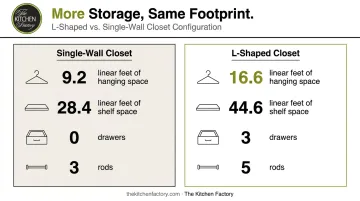
A well-configured L-shaped system can realistically deliver 16.6 linear feet of hanging space, 44.6 linear feet of shelf space, 3 drawers, and 5 rods — a storage density most single-wall closets simply can't match.
The Natural Zoning Advantage
The two arms of the L do something no other layout replicates as cleanly: they create automatic zones without adding any furniture or dividers.
- The first arm handles hanging items: shirts, jackets, dresses, suits
- The second arm takes folded and accessory storage: shelves, drawers, bins
- The corner, when planned deliberately, adds a third functional layer
This mirrors the way most people actually get dressed. You move through the space in sequence, not randomly — and a well-zoned L-shaped closet makes that sequence intuitive.
Corner Space as an Asset
The turning point of an L is where most closet designs fall apart. Poorly planned, it becomes dead space: too narrow for a full rod run, too awkward for standard shelving. Planned well, it's the perfect location for a vertical shoe tower, a pull-out drawer unit, or a mirror station. More on each of these below.
Before You Design: Planning Your Small L-Shaped Walk-In Closet
Planning before purchasing anything saves significant money and frustration. Follow these steps in order.
Step 1: Audit Your Wardrobe First
Before touching a tape measure, count what you own:
- Hanging items — separate long items (dresses, robes at ~52–68 inches) from short items (jackets, shirts at ~36–38 inches)
- Folded items — sweaters, jeans, t-shirts, and anything that doesn't need a hanger
- Shoes — Knape & Vogt's planning guide allocates 9 inches per pair of shoes and 11 inches per pair of boots
- Accessories — belts, bags, jewelry, scarves
This inventory determines how to proportion the two arms — more rod runs for hanging-heavy wardrobes, more shelving and drawer towers for folded-item-heavy ones.
Step 2: Know Your Minimum Dimensions
According to Dimensions.com, L-shaped wrap-around walk-in closets require a 5-foot minimum width along each arm, using a 24-inch standard hanger-rod depth. Knape & Vogt's Closet Hardware Planning Guide confirms 2 feet 6 inches as the minimum passage width for comfortable clearance.
In practical terms: if either arm of your L measures less than 5 feet, you'll need to work with shallower shelving depths and accept tighter clearance.
Step 3: Map Every Architectural Interruption
Measure wall-to-wall, then note:
- Door swing direction and clearance required
- Electrical outlets and light switches
- HVAC vents or ducts
- Any alcoves or irregular wall angles
A single misplaced door swing can eliminate an entire wall of shelving. Catching these obstacles on paper costs nothing — catching them after installation can mean tearing out work you've already paid for.
Step 4: Assign Arms by Traffic Flow
The arm you enter first should hold your most frequently accessed items — daily clothing, everyday shoes. The secondary arm is better suited for seasonal storage, folded pieces, or a vanity station. This traffic-flow logic alone prevents the most common L-shaped closet frustration: reaching past rarely-used items to get to what you need every morning.
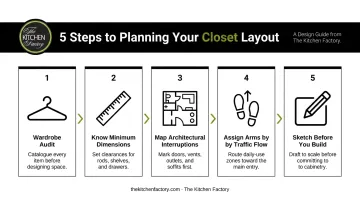
Step 5: Sketch Before You Build
A hand sketch on graph paper or a free digital planner app lets you test multiple configurations in minutes. Use it to confirm rod placement, shelving heights, and drawer tower positions before anything gets ordered or installed.
Small L-Shaped Walk-In Closet Design Ideas
Maximize the Long Wall with Double Hanging Rods
Double-stacked rods along the longer arm instantly double hanging capacity without touching the floor plan. Knape & Vogt recommends placing the top rod at 80–82 inches from the floor and the bottom rod at approximately 40 inches. The upper rod handles shirts, jackets, and shorter items; the lower rod takes folded trousers, blouses, or additional hanging pieces.
One technical note: any rod spanning more than 48 inches requires a center support bracket to prevent sagging.
Use the Corner for a Floor-to-Ceiling Shoe Tower
The interior corner is narrow, which makes it perfect for a tall, dedicated shoe shelving unit. Stagger shelf heights to accommodate different footwear:
- Lower shelves taller (8–10 inches) for boots and wedges
- Upper shelves shallower (5–6 inches) for flats and sandals
A floor-to-ceiling tower in this location keeps the corner productive without blocking access to either arm's rod runs or shelving.
Zone Each Arm by Clothing Category
Assign one arm to hanging garments and the other to drawer towers, open shelves, and bin storage. Category-based zoning mirrors how people actually get dressed: one zone for the outfit, another for underlayers, another for accessories.
Mixing hanging and folded storage on every wall forces you to scan the entire closet for every item. Dedicated zones eliminate that friction completely. A practical split looks like this:
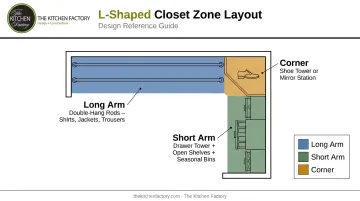
- Long arm: full-length hanging, double-hang shirts and trousers
- Short arm: drawer tower, open shelves for folded items, upper bins for seasonal pieces
- Corner: shoe tower or accessories pull-out
Build a Slim Vanity or Mirror Station into the Corner Turn
The transitional corner area, where the two arms meet, is a natural pause point. It doesn't interrupt rod or shelf runs, making it the right spot for a wall-hung vanity shelf or full-length mirror. A floating shelf at counter height with a mirror mounted above adds genuine dressing-room function while keeping the floor clear.
For smaller primary bedrooms without a dedicated dressing area, this corner station does real work — task lighting mounted above the mirror makes it functional, not just decorative.
Install Floor-to-Ceiling Cabinetry on the Short Arm
The shorter wall of the L is ideal for tall closed cabinetry — hidden storage for seasonal clothing, luggage, and less-accessed items. Contrast this with open shelving on the long arm to balance visual openness with organized concealment. Closed cabinets on the secondary arm also create a cleaner look when the closet door is open.
Add a Narrow Drawer Tower at the End of a Rod Run
Where a hanging rod terminates at a wall, that gap typically runs 12 to 18 inches of unused wall space. A narrow drawer tower fits precisely, storing folded t-shirts, accessories, or undergarments without reducing walking clearance. Four to five drawers in that footprint can hold everything that would otherwise end up on a shelf or in a basket.
Organization Tips to Keep Your L-Shaped Closet Functional
Good design gives your L-shaped closet its structure — organization is what keeps it working. A few habits make the difference between a closet that stays tidy and one that reverts to chaos within a month.
Here are four principles worth building into your routine:
- Claim the vertical space. Shelves that stop at eye level waste the top third of every wall. A high shelf above each rod run — reachable with a small step stool — is ideal for labeled seasonal bins and rarely-used items. That upper zone is free real estate most small closets never use.
- Standardize your containers. Matching woven baskets or white bins make even a densely packed closet look intentional. Mixed bins in random sizes create visual noise and make the space feel smaller than it actually is.
- Rotate by season. Store off-season clothing in labeled, cedar-lined bins on upper shelves to free up prime-access zones for what you're wearing now. In Southern California, mild winters mean winter pieces can stay tucked away for six months or more — a genuine advantage of the climate.
- Divide a shared closet by arm. The L-shape is one of the best configurations for couples. Each arm becomes one person's territory, with their own system and their own routine. Morning conflicts tend to disappear once the space is clearly divided.
Lighting, Mirrors, and Finishing Touches
LED Lighting: The Highest-Impact Upgrade
Lighting transforms a small closet more than any organizational system. According to the U.S. Department of Energy, residential LEDs use at least 75% less energy and last up to 25 times longer than incandescent bulbs — making them the practical choice for a space that's used multiple times daily.
In an L-shaped closet, focus LED strip lights in these locations:
- Under each shelf tier, lighting the rod and items below
- Inside cabinet interiors
- Along the top of the corner section to eliminate the shadow that accumulates there
Architectural Digest recommends recessed puck lights and ribbon lighting at cabinet bases and along shelving — all approaches that work particularly well in small L-shaped spaces where overhead lighting alone leaves dark corners.
Mirrors for Perceived Space
A full-length mirror on the short arm's back wall visually doubles the perceived depth of the closet. Mirrored cabinet door fronts accomplish the same thing while adding concealed storage behind them. In a small L-shaped walk-in, strategic mirror placement can also eliminate the need for a separate dressing mirror elsewhere in the bedroom.
Finishing Details
These details give the closet a finished, intentional look:
- Soft-close drawer hardware on every drawer and cabinet door
- A consistent material palette : matte cabinetry with brushed metal pulls reads as cohesive and deliberate
- A small upholstered bench or ottoman at the corner turn, where there's naturally a pause in the layout
- A decorative pendant or flush-mount fixture overhead to anchor the space visually
Custom vs. DIY: What's Right for Your L-Shaped Closet?
The DIY-Friendly Route
Modular shelving systems from major home retailers can be configured into a functional L-shaped layout at a fraction of custom cost. The Container Store's Elfa Classic kits, for example, start around $507 for a 4-foot configuration and scale from there. IKEA's PAX system offers additional options in the $355–$2,480 range depending on configuration size.
Modular systems work well for:
- Renters who need a non-permanent solution
- Standard-shaped spaces without architectural quirks
- Homeowners testing a layout before committing to a build
The trade-off is precision. Modular systems are designed for standard dimensions, and most L-shaped closets have at least one wall that doesn't cooperate with standard module widths.
The Case for Custom
Custom cabinetry is built to the exact dimensions of your space: every corner utilized, every rod run the precise length it needs to be. Premium materials, integrated LED lighting, glass-front doors, and drawer configurations that match your actual wardrobe are all achievable.
According to Inspired Closets, most custom closet projects run $3,500–$5,000, with the full range stretching from $1,000 to over $10,000 depending on size and materials.
That investment is where custom design earns its value. The Kitchen Factory designs custom closets for clients across greater Los Angeles, applying the same process they bring to kitchens featured in Architectural Digest. Their eight-step process — from an initial vision consultation through space planning, material selection, and on-site installation — ensures the result fits both the room and the person using it.
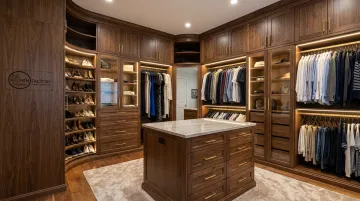
Their primary manufacturing partner, Cabinets by ZePHYR, produces cabinetry from hand-selected, sustainably sourced wood products, a standard that carries through to every closet project. Free consultations are available at their Studio City showroom on Ventura Blvd, open Monday through Saturday, 10 AM to 3 PM.
The Decision Framework
| Situation | Recommendation |
|---|---|
| Renting or temporary space | Modular system |
| Standard dimensions, tight budget | Modular system |
| Irregular dimensions or dead corners | Custom |
| Premium finish expectations | Custom |
| Long-term home with daily use priority | Custom |
Frequently Asked Questions
What is the minimum size for a small L-shaped walk-in closet?
Dimensions.com lists 5 feet as the minimum width for each arm of an L-shaped wrap-around closet, using a standard 24-inch hanger-rod depth. Spaces slightly under that threshold can still work with shallower custom shelving, though clearance becomes tighter.
How do I make the most of the corner in an L-shaped closet?
The corner works well for a vertical shoe tower, a wall-mounted mirror station, or a narrow pull-out drawer unit — each fits the turning point without blocking access to either arm's rod runs.
Should I use open shelving or closed cabinets in a small L-shaped closet?
A mix works best. Open shelving on the main hanging arm keeps clothing visible and accessible; closed cabinets on the secondary arm conceal seasonal and less-used items, creating a tidier look when the closet door is open.
What's the best way to organize a shared L-shaped walk-in closet for two people?
Divide the two arms by owner. Each person gets their own dedicated hanging space, folding zone, and accessory storage. The separation eliminates overlap and makes the morning routine far more efficient than a mixed-ownership layout.
How much does a custom L-shaped closet system typically cost?
Costs vary based on materials, size, and configuration. Custom systems generally run $3,500–$5,000, though the full range stretches from around $1,000 to well over $10,000. Getting quotes from design firms in your area gives you the most accurate estimate for your specific space.
Can I fit a vanity or seating area into a small L-shaped walk-in closet?
Yes. A wall-hung vanity shelf at the corner turn and a slim ottoman at the end of a rod run are both practical options. Neither requires sacrificing meaningful storage, and both add real dressing-room functionality to the space.