Among Los Angeles homeowners, there's been a clear shift away from stock and semi-custom options toward fully custom cabinetry. Not because it's a status symbol, but because a kitchen built around how you actually cook and entertain performs in ways a showroom floor arrangement simply cannot.
This article breaks down why custom cabinetry has become the preferred choice for discerning homeowners, what you sacrifice with off-the-shelf alternatives, and how to work with the right design partner to get it right the first time.
Key Takeaways
- Custom cabinets are built to your kitchen's exact dimensions — no filler strips, no wasted corners
- Complete design control means your kitchen reflects how you actually live, not how a catalog is arranged
- Higher-grade materials and construction methods translate to decades of reliable daily use
- A well-executed kitchen remodel can return over 100% in the Pacific region, per Zonda's 2025 Cost vs. Value Report
- Full-service design firms coordinate cabinetry, countertops, and appliances as one cohesive system
What Is Custom Cabinetry?
Custom cabinetry is designed, sized, and built from scratch to match a specific kitchen's dimensions, functional requirements, and aesthetic goals. That distinction matters when you understand how the alternatives work.
The three categories:
- Stock cabinets — Pre-manufactured in fixed standard sizes, available immediately off the shelf
- Semi-custom cabinets — Allow limited modifications to pre-existing frames and door styles
- Custom cabinets — Built entirely around your space, with no preset size constraints or style limitations
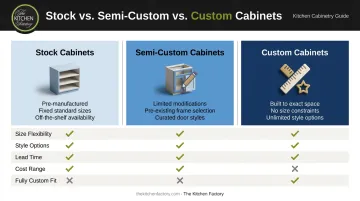
According to KraftMaid, standard wall and base cabinets start at 6 inches wide and increase in 3-inch increments up to 48 inches. That math rarely aligns with how real kitchens are actually shaped.
When fixed-size products can't accommodate non-standard layouts, high ceilings, architectural features, or specific storage demands, custom cabinetry becomes the practical solution — not a premium indulgence. That situation applies to most older Los Angeles homes, where original floor plans rarely follow modern standard dimensions.
Key Advantages of Custom Cabinetry in Kitchen Remodels
The advantages below go beyond aesthetics. They address outcomes homeowners feel every time they walk into and use their kitchen.
Perfect Fit for Every Layout — No Wasted Inch
Stock cabinets are manufactured in fixed increments, which almost always leaves gaps, filler strips, or underutilized corners when kitchens don't conform to standard dimensions. In Los Angeles, that's common. USC Neighborhood Data for Social Change reports the median year built for LA housing stock is 1965 — older than both California's and the national median — meaning sloped ceilings, exposed beams, irregular footprints, and out-of-plumb walls are the norm, not the exception.
Custom cabinetry is built around the actual space. Designers account for every variable:
- Sloped ceilings and exposed beams
- Window and vent placements
- Appliance dimensions and locations
- Corner solutions (lazy Susans, blind-corner drawers, diagonal cabinets)
- Pull-out shelving, integrated spice racks, and deep drawer storage
The functional payoff is immediate. When storage is proportional to your actual needs and logically placed, counter clutter drops, meal prep flows more naturally, and the kitchen feels larger than its square footage suggests.
This advantage matters most in older homes, kitchens undergoing structural changes, and high-end remodels where visual consistency from cabinet edge to edge is non-negotiable.
Unlimited Design Expression — A Kitchen Built Around How You Live
Custom cabinetry gives you complete control over every design variable:
- Wood species — maple, walnut, cherry, white oak, and more
- Door style — shaker, flat-panel, inset, raised panel
- Finish — painted, stained, lacquered, or hand-detailed
- Hardware — pulls, knobs, integrated handles, or no hardware at all
The result is a kitchen that reflects your taste and lifestyle rather than a catalog's interpretation of it. At The Kitchen Factory, the design process starts by understanding how a homeowner actually cooks and entertains. That means the cabinetry layout — the interior configurations, the dedicated zones, the drawer depths — supports your real habits.
A serious home baker needs different drawer dimensions and counter heights than someone who primarily heats and serves. A dedicated coffee station requires different cabinetry planning than a wine storage zone — and those distinctions drive every layout decision.
There's also a durability argument for custom design that has nothing to do with materials. NKBA's 2026 Kitchen Trends Report identifies transitional and timeless kitchen design as the top style, with 72% of industry professionals naming it the most popular approach for the next three years. A kitchen designed around your genuine preferences and built in timeless materials holds its appeal year over year — it doesn't become a dated version of whatever was trending when you renovated.
For luxury properties and architecturally distinctive homes, that longevity is part of the investment thesis — not just an aesthetic preference.
Superior Craftsmanship and Lasting Return on Investment
Construction quality is where the difference between custom and stock becomes most tangible. Stock cabinets are frequently built with particleboard or MDF carcasses and thin veneers. Custom cabinets, by contrast, typically feature:
- Solid hardwood or high-grade plywood construction
- Dovetail drawer joints for structural integrity
- Full-extension drawer glides for daily usability
- Soft-close hinges and concealed undermount slides
- Multi-step catalyzed finishes that resist kitchen conditions
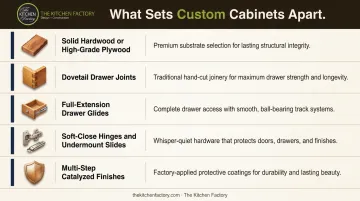
Each of those specs directly affects how the cabinet performs after 50,000 open-and-close cycles — not just how it looks on install day. The KCMA A161.1-2022 performance standard requires doors and loaded drawers to complete 25,000 cycles, with finishes tested against vinegar, lemon juice, and alcohol exposure. Quality custom cabinetry is engineered to pass those tests with margin to spare.
Many premium manufacturers back their products with lifetime warranties to the original homeowner.
Zonda's 2025 Cost vs. Value Report shows a minor kitchen remodel in the Pacific region returns 129% — meaning homeowners recoup more than they spent. Zillow reports that 57% of buyers consider their preferred kitchen style extremely or very important in a purchase decision, and NAR data shows 48% of Realtors have seen increased buyer demand for kitchen upgrades over the prior two years.
Cabinetry is where that investment is most visible — and most scrutinized.
What You Sacrifice With Stock or Semi-Custom Cabinets
Stock cabinetry costs less upfront — but that savings comes with real compromises worth understanding before you commit.
Common frustrations homeowners encounter:
- Filler strips that become more noticeable over time as finishes age differently
- Cabinet boxes that don't align with ceiling height or crown molding
- Interior configurations that don't match actual cookware, pantry inventory, or appliance sizes
- Finishes that chip or delaminate under normal kitchen conditions
Cabinets that fail structurally or aesthetically early in their lifespan require replacement on a compressed timeline. That compressed timeline erodes the upfront savings quickly. Quality custom cabinets built from proper materials and joinery are backed by manufacturer lifetime warranties — a standard most stock products don't meet.
Design cohesion is the other long-term cost. When stock cabinets are used, integrating later updates becomes difficult — new countertops may not align cleanly, a kitchen island addition may not match cabinet height or depth, an appliance upgrade may expose a gap the original layout never accounted for.
Custom cabinetry, designed with your kitchen's full evolution in mind, accommodates those changes without requiring you to start over.
Houzz's 2024 Kitchen Trends Study found that 45% of renovating homeowners chose custom cabinets, 35% chose semi-custom, and only 9% chose stock — a pattern that reflects what homeowners learn after living with the results of each option.
How to Work With a Custom Cabinetry Designer
Getting the most from a custom cabinetry investment starts before any measurements are taken.
What a Great Consultation Covers
A skilled designer should understand more than your kitchen's dimensions. The NKBA's Kitchen Design Survey Form — the industry's standard assessment tool — covers:
- Household members' heights and physical considerations
- Primary cook habits and daily cooking patterns
- Guest frequency and how guests interact with the space
- Full storage inventory of cookware, pantry items, baking equipment, and specialty vessels
Those answers drive layout decisions. A household that cooks from scratch daily needs different storage frontage, workflow clearance, and interior configurations than one that primarily entertains. NKBA's 2022 planning guidelines recommend a minimum of 1,400 inches of total shelf and drawer frontage for a small kitchen, scaling to 2,000 inches for a large one — numbers that stock cabinet layouts rarely achieve.
The Value of Full-Service Coordination
Working with a firm that handles the project from concept through installation changes the outcome. When cabinetry, countertops, appliances, lighting, and finishes are coordinated by the same team, every decision supports the final result rather than competing with it.
The Kitchen Factory operates as exactly this kind of end-to-end design partner for luxury kitchen projects throughout Los Angeles. Their eight-stage Design to Build process covers:
- Initial vision and lifestyle assessment
- Cabinet dimensioning confirmed against appliance specifications
- Countertop templates cut after cabinet installation
- Sequenced deliveries to minimize disruption through final installation and care guidelines
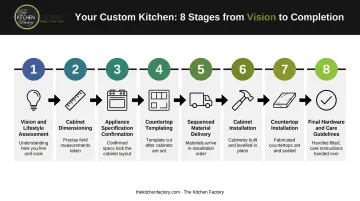
That sequencing removes the miscommunication that surfaces when separate vendors operate without a shared plan.
Ask your designer how each material and layout decision will age — not just visually, but structurally. A designer who answers that with project-specific reasoning, not a general reassurance, is worth the investment.
Conclusion
Custom cabinetry's popularity in kitchen remodels comes down to measurable, daily advantages — a kitchen that fits the space precisely, works around the owner's actual habits, and is built to last.
In Los Angeles — a market defined by architectural diversity, older housing stock, and homeowners who expect a high standard of design — custom cabinetry isn't a luxury upgrade. It's the logical foundation of any remodel done right. The Kitchen Factory has delivered that kind of end-to-end work across the greater Los Angeles area for over 30 years — handling everything from the initial design consultation through countertop selection and final hardware installation. That continuity, from concept to completion, is what separates a kitchen that looks good in photos from one that holds up in daily use.
Frequently Asked Questions
What are the benefits of custom kitchen cabinets?
Custom cabinets offer three core advantages over stock options:
- Precise fit for any layout, including non-standard dimensions
- Full design control over wood species, door style, and finish
- Superior construction using hardwoods and proper joinery for lasting durability and home value
Are wood cabinets coming back in 2026?
Wood cabinetry has overtaken white as the top cabinet choice, with wood at 29% versus white at 28% according to Houzz's 2026 study. White oak leads at 51% among wood species, part of a broader shift toward warmer, more organic palettes over the all-white kitchens of the previous decade.
What kitchen color will not date?
Neutral, nature-inspired palettes — warm whites, greige tones, soft sage greens, and natural wood stains — hold up best across changing design trends. Anchor the kitchen in these timeless materials and introduce bolder color through easily swapped elements like hardware or a backsplash.
What is the 1/3 rule for cabinets?
The 1/3 rule divides cabinetry into proportional thirds — typically upper cabinets, lower cabinets, and open or glass-front sections. Breaking up uniform cabinet runs this way prevents a heavy, monotonous look and creates more visual rhythm across the space.
Is custom cabinetry worth the investment compared to stock cabinets?
For homeowners planning to stay for 10 or more years, or those in higher-value markets like Los Angeles, custom cabinetry consistently delivers better long-term value through superior durability, better space utilization, and a stronger contribution to resale value — despite the higher upfront cost.
How long does it take to get custom cabinets made and installed?
Custom cabinet lead times typically range from 8 to 16 weeks depending on design complexity and manufacturer capacity. Working with a full-service firm like The Kitchen Factory allows homeowners to plan sequencing alongside countertop delivery, appliance installation, and other remodel phases to keep the project moving efficiently.