Introduction: Designing a Kitchen That's Both Luxurious and Family-Friendly
Many homeowners in Los Angeles assume they have to choose: either a kitchen that photographs beautifully and impresses guests, or one that survives the reality of school mornings, homework sessions, and Saturday cooking with the kids. That's a false choice.
Luxury and family-friendliness aren't competing priorities — they reinforce each other when the design starts with how a household actually lives, not just how the space should look.
According to the 2024 Houzz Kitchen Trends Study, 64% of homeowners who opened up their kitchen layouts cited improved functionality as the primary reason, and 28% did so specifically to increase family time. For homeowners making a serious investment, function and beauty are equally non-negotiable.
Here's how to get both right.
Key Takeaways:
- The best family kitchens are designed around how you actually live — not just how they look in photos
- The right layout creates natural zones that protect cooking areas while keeping kids engaged
- Material selection determines long-term durability without compromising aesthetics
- Integrated storage and smart appliances do the heavy lifting invisibly
- Start any LA remodel with a lifestyle consultation before touching a floor plan
What "Luxury Family-Friendly" Actually Means
Beyond Childproofing an Expensive Kitchen
A truly family-friendly luxury kitchen isn't one where someone bolted cabinet locks onto custom millwork after the fact. It's a space where every design decision — from layout to edge profiles to finish selection — was made with the whole household in mind from day one.
The difference matters. Standard "kid-friendly" design prioritizes safety above all else and often shows it: plastic corner guards, visible locks, wipeable vinyl floors. Luxury family design achieves the same safety outcomes through material science, spatial planning, and thoughtful detailing — with no visual evidence of the effort.
Every element needs to clear two bars simultaneously: it has to look like a considered design choice, and it has to survive daily life with multiple people in the room. Timeless finishes, clean architectural lines, and premium materials that age gracefully — those aren't in conflict with durability. The best family kitchens prove they never were.
Designing for How Families Evolve
One of the most overlooked principles in family kitchen design is longevity. A six-year-old becomes a fifteen-year-old. The snack drawer becomes a study station. The kitchen needs to adapt to those shifts without requiring a full remodel every decade.
Designing for longevity means:
- Selecting materials that age well rather than simply show wear
- Building in adjustable or multi-use zones that flex with the household
- Avoiding choices built around only one life stage
At The Kitchen Factory, every project opens with a lifestyle consultation — not a materials presentation. The team works to understand how a family actually cooks, how children use the space, and what the household will need over the next decade. That context drives every design decision, which is why their kitchens for LA families hold up visually and functionally long after installation.
Layout Planning: Open Flow, Work Zones, and Sight Lines
The Open-Concept Advantage for Families
An open or semi-open floor plan does more than look spacious. It gives parents direct sight lines to adjacent living areas while cooking. That visibility is genuinely useful when children are young, and it remains valuable as a social hub as they grow older.
NKBA's Kitchen Planning Guidelines define the classic work triangle — the distances between cooking surface, prep sink, and refrigerator — with clear parameters: no leg shorter than 4 feet or longer than 9 feet, and total perimeter under 26 feet. In a luxury family kitchen, this triangle anchors the chef's zone while leaving the surrounding space open for family activity without interference.
The Island: The Kitchen's Most Versatile Element
The island is where luxury family kitchen design earns its square footage. A well-configured island handles:
- Homework and device use during after-school hours
- Snack prep and casual breakfast without entering the cooking zone
- Casual counter dining for everyday meals
- Entertaining bar setup when guests arrive
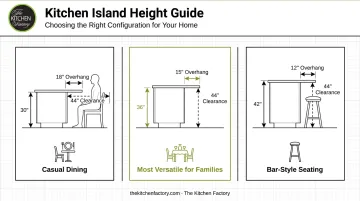
The 2024 Houzz Kitchen Trends Study found 42% of homeowners now choose islands 7 feet or longer. NKBA recommends specific seating knee-space depths based on counter height: 18 inches at 30-inch height, 15 inches at 36-inch height, and 12 inches at 42-inch height — with 44 inches of clearance behind seated diners for comfortable traffic flow.
For most luxury family kitchens, a 36-inch island height with a 15-inch seating overhang creates a counter that works for cooking, homework, and casual dining without feeling like a commercial bar.
Positioning Child-Accessible Zones
Keeping child-accessible storage away from cooking zones is less about restriction and more about smart placement. Locate these elements at the kitchen's periphery or near the dining area:
- Snack drawers and drink refrigeration drawers within easy reach of the dining zone
- Child-height cabinet clusters positioned away from the range and prep sink
- A lower prep counter or built-in step-stool space integrated cleanly into the cabinetry
This separation keeps curious hands away from hot surfaces and sharp tools without visible locks or barriers disrupting the design.
Premium Materials That Withstand Real Family Life
Countertop Options Worth Considering
Not all luxury surfaces perform equally under family conditions. Here's how the three top options compare:
| Material | Water Absorption | Stain/Scratch Resistance | Heat Tolerance | Best For |
|---|---|---|---|---|
| Engineered Quartz | ≤0.05% (Caesarstone) | Excellent; nonporous | Moderate — use trivets | Maximum low-maintenance durability |
| Leathered Granite | 0.05%–0.40% (NSI) | Excellent scratch resistance | ~250°C / 480°F — avoid direct heat | Natural stone look; hides fingerprints |
| Porcelain Slab | Nonporous (MSI Stile) | Engineered stain/scratch resistance | High heat resistance | Nearly indestructible; dramatic aesthetics |

For most families, engineered quartz is the practical choice. Caesarstone, Cambria, and Silestone all offer premium finishes with GREENGUARD Gold and NSF-51 food-safety certifications, and none require sealing. Cambria provides a 25-year warranty on registered surfaces.
Leathered granite earns its place in luxury family kitchens for one specific reason: the textured finish actively conceals fingerprints, smudges, and water spots better than polished stone — a genuine daily advantage.
Cabinetry Finishes and Hardware
A few cabinet choices make an outsized difference in a working family kitchen:
- Semi-gloss or high-gloss finishes wipe clean easily and hold up to repeated washing
- Full-overlay frameless construction eliminates face-frame crevices where crumbs accumulate
- Soft-close hinges and drawer glides prevent slamming, protect fingers, and add no visible hardware to the design
These details cost relatively little to include at build time and deliver returns on every single use.
Flooring and Edge Profiles
Large-format porcelain tile is a strong flooring choice for luxury family kitchens: durable, low-maintenance, and available in realistic stone looks. For safety, ANSI A326.3-2021 requires a wet DCOF rating of 0.42 or greater for level interior floors walked on when wet — confirm this spec before finalizing your tile selection.
Two finishing details are worth addressing near high-traffic zones:
- Edge profiles: A slightly eased or beveled countertop edge reduces injury risk without the builder-grade look of a full bullnose
- Full-height stone backsplashes: Matching the countertop material eliminates grout lines entirely, cutting cleaning time while sharpening the overall aesthetic
Smart Storage That Looks Custom, Not Cluttered
Custom cabinetry does most of the organizational work in a luxury family kitchen — invisibly. Deep pull-out drawers, full-extension pantry systems, and soft-close base cabinets contain far more than open shelving while keeping the kitchen architecturally clean.
The most practical custom storage elements for family kitchens:
- Dedicated child-zone drawer cluster — positioned at child height, stocked with unbreakable dishware, approved snacks, and school supplies. Gives children access and independence without touching the cooking zone
- Pull-out recycling and compost systems — Houzz 2024 data shows these are the most requested specialty storage feature, chosen by 66% of renovating homeowners. Rev-A-Shelf's waste systems include soft-close and touch-to-open options that sit flush with the cabinetry face
- Built-in appliance garages — roll-up or pocket-door enclosures (Häfele's Milano kit yields approximately 24" x 18" of concealed storage) tuck countertop appliances behind cabinet doors, keeping counters clear and the kitchen visually open
- Hidden charging drawers — built directly into a cabinet run, these keep devices powered, off the counter, and completely out of sight
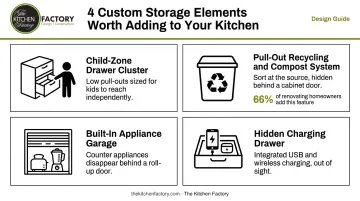
None of these require visible organizers or after-market additions. The storage is engineered into the cabinetry itself — which is exactly what makes it look custom rather than assembled.
Family-Ready Appliances with High-End Performance
Why Induction Cooktops Belong in a Family Kitchen
For a family kitchen, induction is the most defensible choice. Consumer Reports confirms induction boils water 2 to 4 minutes faster than gas or electric, responds immediately when heat is adjusted, and maintains steady simmer temperatures better than either alternative.
The family-specific advantage: the glass surface doesn't get as hot as a traditional range — it heats cookware only when magnetic cookware is detected. There's no open flame, and residual heat is significantly lower than gas after cooking ends.
Premium induction lines from Miele, Wolf, Thermador Liberty, and Bosch Benchmark now rival professional gas ranges aesthetically. Wolf models include a lock mode that engages automatically after 10 idle minutes, while Miele offers a full system safety lock on every cooktop — both standard features, not upgrades.
Appliances That Integrate Like Furniture
Beyond the cooktop, how appliances are positioned and concealed shapes both safety and aesthetics throughout the kitchen:
- Wall ovens at adult height keep hot surfaces away from children and reduce strain during heavy cooking sessions
- Panel-ready dishwashers (Miele fully integrated models; Bosch 800 Series with child lock) disappear behind matching cabinetry fronts — visually indistinguishable from the cabinet run
- Column refrigerators (Sub-Zero Designer Series) or French door models with dedicated lower snack drawers give children access to their zone without opening primary food storage
Smart appliance integration adds a practical safety layer: Wi-Fi-enabled ovens with auto-shutoff, refrigerators with interior cameras and inventory tracking (GE Profile Kitchen Assistant, Samsung Family Hub), and Thermador Home Connect for remote monitoring.
Lighting, Multi-Functional Spaces, and Finishing Details
Three-Layer Lighting for a Kitchen That Does Everything
A luxury family kitchen needs to shift between homework-bright and dinner-party atmospheric — often on the same evening. That flexibility comes from a three-layer lighting plan:
- Ambient: Statement pendant fixtures or recessed lighting on dimmers handle general illumination and set the room's mood
- Task: Under-cabinet LED strips over prep areas and the island surface. American Lighting's cabinet lighting products deliver up to 460 lumens per linear foot with tunable white ranges from 2700K to 6000K — meaning the color temperature can shift from warm to cooler based on the activity
- Accent: Toe-kick lighting and glass cabinet illumination add depth after hours and shift the kitchen's personality entirely when dimmed
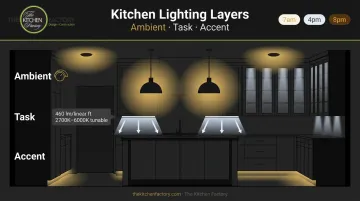
Dimmer controls on all three layers make this work. The same physical kitchen reads completely differently at 7am, 4pm homework time, and 8pm dinner service.
The Butler's Pantry: Protecting the Main Kitchen's Aesthetic
Multi-functional design doesn't stop at the island — it extends into how the whole space is organized around your family's daily life. A butler's or utility pantry adjacent to the main kitchen is one of the highest-value investments in a luxury family home. It absorbs everything that visual clutter typically steals from a kitchen: school bags, bulk grocery storage, pet supplies, countertop appliances, and secondary refrigeration.
When the everyday noise of family life has somewhere to go, the main kitchen stays clean, composed, and ready for whatever comes next. The Kitchen Factory incorporates pantry planning into the overall kitchen scope — treating it as part of the design rather than a separate afterthought.
A built-in organization hub keeps household logistics off the countertops entirely. Common solutions include:
- A concealed charging station tucked behind a cabinet door
- A chalkboard panel set into a cabinet end for schedules and notes
- A pull-out message board that disappears when not in use
Frequently Asked Questions
Can a luxury kitchen truly be kid-safe without compromising aesthetics?
Yes. Intentional material choices (rounded or eased edge profiles, nonporous surfaces, soft-close hardware) achieve genuine safety without any visible childproofing. Layout planning that positions child zones away from cooking areas does the rest. Nothing needs to look like a safety measure.
What countertop material is best for a high-end family kitchen?
Engineered quartz leads for most families: nonporous, stain-resistant, and available in high-end finishes from Caesarstone, Cambria, and Silestone. Leathered granite is a strong natural stone alternative, as its textured finish actively hides fingerprints and water spots.
What kitchen layout works best for families with young children?
An open-concept or semi-open layout with a central island. It maximizes sight lines to adjacent living areas and lets the island function as a homework station, snack zone, and prep surface — all without creating traffic conflicts near the range.
Are induction cooktops worth it for a family kitchen?
For families, yes. The surface stays cooler because the glass heats cookware rather than the surrounding area, which meaningfully reduces burn risk. Modern induction cooktops from Wolf, Miele, and Thermador match professional gas range performance, and built-in lock modes on premium models add a practical safety layer.
How do I keep a family kitchen looking luxurious when kids are involved daily?
Choose materials that age gracefully rather than show wear: matte or satin cabinet finishes, leathered stone countertops, large-format porcelain floors. Build in dedicated child zones that contain mess to one area. Keep the main aesthetic free of visible organizers or childproofing hardware.
How do I start planning a luxury family-friendly kitchen remodel in Los Angeles?
Start with a lifestyle consultation that covers how your family cooks, how children use the space, and your long-term aesthetic goals. The Kitchen Factory in Studio City has designed luxury kitchens for LA homeowners for over 30 years, always beginning with how you live before touching a floor plan. Call 818.505.1546 or visit the showroom at 12610 Ventura Blvd, Studio City.