The kitchen is the most personal room in any home. It's where cooking becomes ritual, where guests inevitably congregate, and where design choices outlast every trend cycle. Getting it right demands more than expensive materials. It requires a plan.
This guide covers everything that defines a truly exceptional kitchen renovation: layout and cabinetry, countertops and backsplashes, chef-grade appliances, lighting, 2026 design trends, and realistic cost expectations — grounded in over 30 years of luxury kitchen design across Southern California.
Key Takeaways
- Luxury is defined by intentional design and premium materials, not price alone
- Layout and cabinetry form the structural foundation; every other decision follows
- Countertops and backsplashes make your boldest design statement; material choice should match how you cook
- Chef-grade appliances and specialty features elevate daily use and long-term enjoyment
- Upfront planning is what makes a renovation last
What Sets a Luxury Kitchen Apart
Luxury isn't a price point. The 2026 Houzz Kitchen Trends Study found that the top 10% of kitchen renovation spenders invested $150,000 or more — but spending that figure on the wrong things still produces a generic result.
What separates a truly luxury kitchen from a costly cosmetic upgrade comes down to three pillars:
- High-quality materials selected for durability and natural character, not just visual impact
- Bespoke design built around how you actually cook, entertain, and live
- Integrated functionality where every element — storage, workflow, lighting, appliance placement — works as a system
From Utilitarian to Social Hub
The enclosed kitchen of previous decades has all but disappeared from Los Angeles homes. According to the NKBA's 2026 Kitchen Trends Report, 76% of design experts expect kitchen footprints to increase, with open layouts growing as kitchens become multipurpose entertaining hubs.
That shift reorders design priorities entirely. A kitchen that opens to a living or dining room must perform visually from multiple angles, handle social traffic, and integrate seating, prep zones, and appliances without feeling chaotic.
Dennis McAllister, owner of The Kitchen Factory, keeps this front and center in every project: "I like to design kitchens with cooking in mind and that stands out due to its uniqueness."
Senior Designer David Miller puts it plainly: "Eating can be a ritual, it begins relationships, it cements friendships, it makes us happy." A luxury kitchen earns that role through design, not décor.
Layout and Cabinetry: The Foundation of Luxury Kitchen Design
No countertop or appliance can compensate for a poorly planned layout. The spatial framework has to come first — before a single product is specified or a cabinet is drawn.
From Work Triangle to Multi-Zone Planning
The traditional work triangle — sink, cooktop, refrigerator — was designed for solo cooking in compact spaces. Modern luxury kitchens replace it with dedicated zones:
- Prep zone — ample counter run adjacent to the sink, ideally with a secondary prep sink
- Cooking zone — range or cooktop with landing space on both sides and clear ventilation above
- Entertaining station — beverage center, wine storage, or secondary cooktop near the island seating
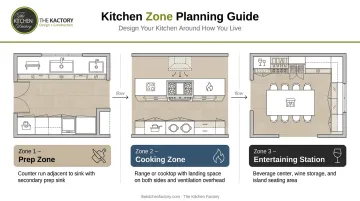
Zone planning requires the designer to understand how the household actually uses the kitchen before a single cabinet is drawn.
Island Design as a Purpose-Driven Decision
The island is often the most debated element in a luxury kitchen — and the most consequential. Size, shape, and secondary features should all follow function:
- A waterfall-edge island creates a dramatic material statement and defines the room's focal point
- A double island separates prep from entertaining — the go-to configuration for frequent hosts
- Integrated prep sinks, wine storage, and warming drawers transform an island from a surface into a full secondary kitchen station
- Seating configuration — overhang depth, stool clearance, knee space — needs to be resolved in the design phase, not retrofitted
Custom Cabinetry Construction
Cabinetry is where budget allocation has the most lasting impact. The construction method sets the quality ceiling for everything else.
| Construction Type | What It Means | Luxury Application |
|---|---|---|
| Frameless (full-access) | No front frame; European-style; more interior access | Sleek, contemporary kitchens |
| Face-frame | Hardwood frame on cabinet front; traditional look | Classic and transitional styles |
| Inset doors | Doors sit flush within the frame | Refined, furniture-quality finish |
| Full overlay | Doors cover most of the frame | Clean, modern appearance |
The Kitchen Factory sources custom cabinetry from trusted manufacturers including Cabinets by ZePHYR, Columbia Cabinets, and Eclipse Cabinetry — each offering distinct construction approaches and finish capabilities. Eclipse's full-access frameless construction, for example, provides up to 10% more interior storage than framed alternatives, a meaningful gain in kitchens where organization is essential.
Furniture-quality finish details — wainscot panel ends, crown molding profiles, and custom interior organization — are what separate cabinetry that looks built-in from cabinetry that looks custom-built.
Finishes and Hardware
Cabinet finish sets the entire aesthetic tone of the kitchen. Current directions worth considering:
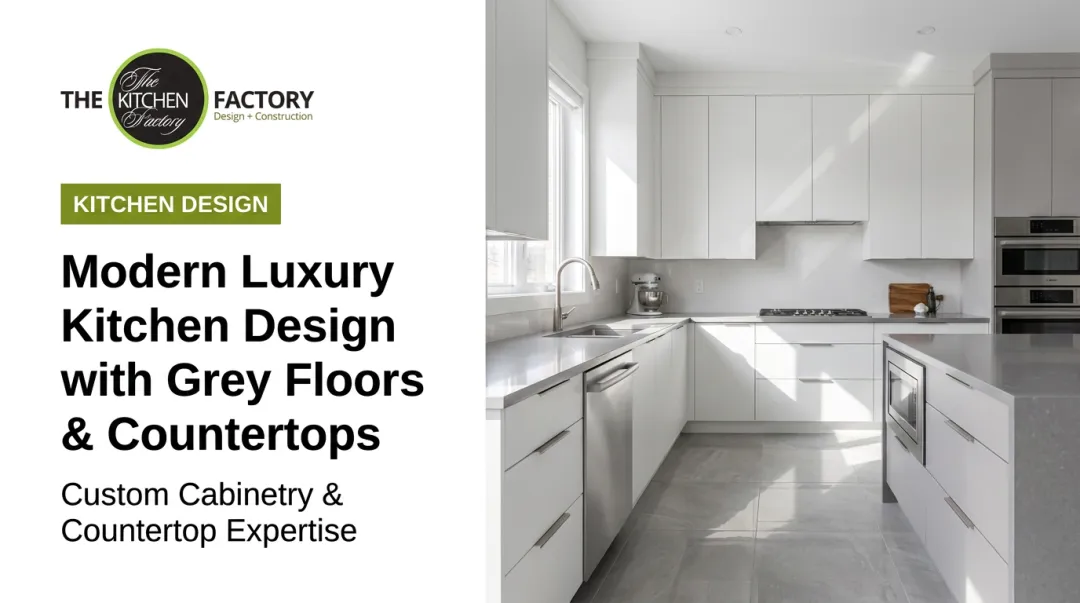
- Paint grade finishes in warm whites, sage greens, or deep navy for clean, contemporary reads
- Stain grade wood in white oak or walnut for warmth and natural texture
- Two-tone combinations — a darker island against lighter perimeter cabinetry — add depth without visual clutter
Hardware is what completes the picture. At this level, every detail matters:
- Full-extension ball-bearing drawer slides — the functional baseline; anything less shows in daily use
- Mixed metal pull finishes — brushed brass, matte black, and unlacquered bronze add material contrast without competing with cabinetry
- Glass cabinet doors — work both decoratively and functionally, particularly in upper cabinets flanking a range hood
Countertops, Backsplashes, and Flooring That Make a Statement
Surface materials are your most visible design investment — and where maintenance realities most often collide with aesthetic ambition.
Choosing Your Countertop Material
| Material | Durability | Maintenance | Best For |
|---|---|---|---|
| Marble | Natural stone; can develop patina | Porous; can etch from acids (lemon juice, vinegar); stains from wine and oil | Clients who appreciate natural character and are willing to care for it |
| Quartzite | Very hard natural stone | Similar to granite; still requires periodic care | Clients who want marble's look with better durability |
| Engineered Quartz | Highly durable | Non-porous; stain resistant; never needs sealing | High-use kitchens; lower maintenance preference |
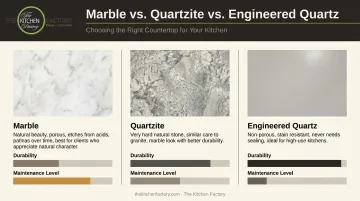
According to Use Natural Stone, marble is worth choosing only if you're honest about your cooking habits — it demands real care. Engineered quartz brands like Cambria and Caesarstone skip that calculus entirely: non-porous, stain-resistant, and never requiring sealing — a practical edge for kitchens that see real daily use.
The Full-Slab Backsplash
One of the most impactful moves in a luxury kitchen is replacing a tiled backsplash with a continuous stone slab running from countertop to ceiling. The 2026 Houzz Kitchen Trends Study reports 28% of renovators now choose slab-style backsplashes — up from 24% the prior year.
A single uninterrupted piece of stone showcases natural veining at a scale that tile grids can't replicate. It also eliminates grout maintenance. The material choice matters: engineered quartz accounts for 39% of slab backsplash selections, quartzite 33%.
The 60-30-10 Material Coordination Rule
A useful framework for balancing materials across the kitchen:
- 60% — dominant material (cabinetry color and finish)
- 30% — secondary material (countertops and backsplash)
- 10% — accent (hardware, lighting fixtures, decorative elements)
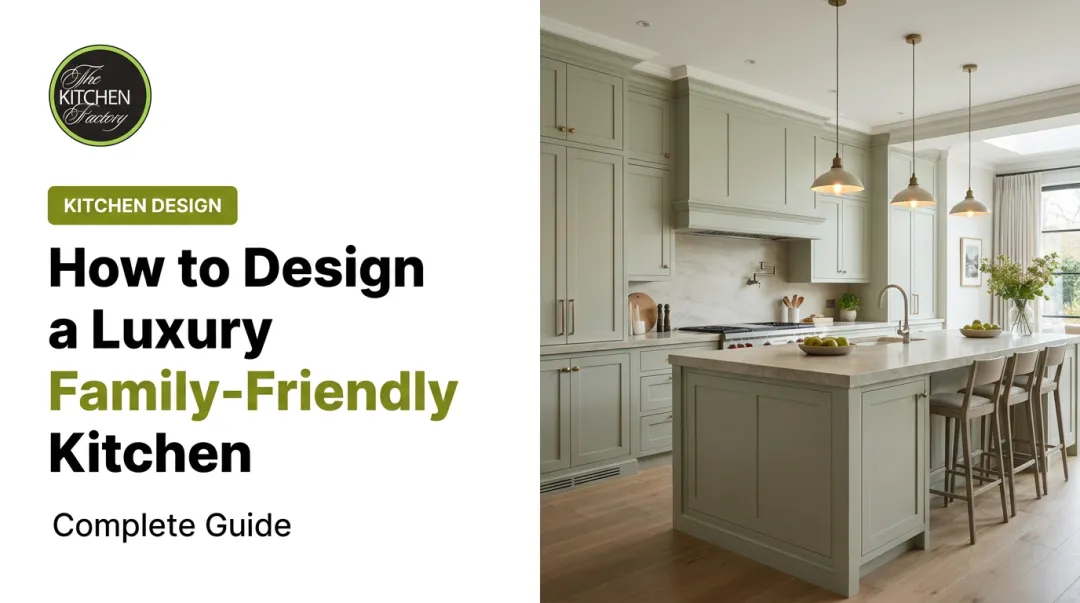
This proportion creates visual balance without looking contrived. A sage green perimeter cabinet (60%), white quartzite countertop and full-slab backsplash (30%), and brushed brass hardware (10%) reads as cohesive rather than busy.
Flooring Options
- Wide-plank hardwood — warm and perennially popular, but moisture sensitivity is a real consideration in cooking-heavy kitchens
- Large-format porcelain — according to Daltile, extra-large porcelain surfaces offer low porosity, scratch resistance, and heat resistance with near-seamless visual results
- Natural stone — limestone and marble add glamour but require maintenance similar to countertop stone
- Two-tone combinations — a patterned tile beneath the island with hardwood on the perimeter defines zones and adds custom character
Chef-Grade Appliances and Specialty Features Worth the Investment
Professional-Grade Ranges
The range is the functional and visual centerpiece of any serious kitchen. Brands like Wolf offer gas, dual-fuel, and induction configurations with multiple burner layouts, built-in griddles, and a redesigned 15,000 BTU griddle option. La Cornue's CornuFé positions itself for high culinary standards, while the Château series is positioned as a bespoke, artistic kitchen asset.
A 48-inch range changes the planning equation: cabinetry on both sides must provide proper landing space, and ventilation must be sized and positioned to handle the output — all decisions that need to be locked in during the design phase, not the construction phase.
Panel-Ready and Integrated Appliances
The move toward integrated appliances is one of the clearest markers of luxury kitchen design. The NKBA's 2026 report found panel-faced dishwashers in 85% of projects and panel-faced refrigeration in 72%. When appliances disappear into the cabinetry line, the kitchen reads as a cohesive designed environment rather than a collection of equipment.
This requires advance planning. Panel dimensions, hinge clearances, and door alignment must be resolved before cabinetry is ordered — retrofitting an integrated look after the fact rarely works.
Specialty Features That Earn Their Place
The following additions move a kitchen from beautiful to genuinely exceptional for cooks and entertainers:
- Built-in espresso machine: integrated into the cabinetry line as a dedicated coffee station, flush with surrounding panels
- Wine cooler or beverage center: the Houzz 2026 study found 24% of renovators add beverage stations; wine fridges appeared in 17% of projects
- Warming drawers: Wolf's models hold 80°F to 200°F, keeping dishes ready without drying them out
- Steam ovens: NKBA reports 66% of design professionals now include steam cooking in luxury projects
- Dual dishwashers: ideal for frequent entertainers, and straightforward to integrate into symmetrical cabinetry runs
Beyond these, features like pot fillers over the range, extra-deep prep sinks, and dedicated secondary prep zones are what serious cooks notice most — and what planners often underestimate until they're missing them mid-renovation.
Lighting, Color, and 2026 Design Trends
Layered Lighting in Luxury Kitchens
A well-lit luxury kitchen uses three distinct layers:
- Ambient lighting — recessed cans, statement chandeliers, or flush ceiling fixtures that establish overall brightness
- Task lighting — under-cabinet LED strips that illuminate prep surfaces without shadows
- Accent lighting — toe-kick lighting, backlit glass cabinets, and low-voltage fixtures that highlight architectural details
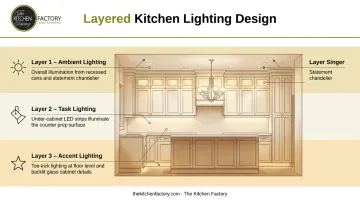
The NKBA found lighting treated as a decorative focal point in 87% of projects, with pendants favored by 63% of design professionals. Pendant fixtures over the island pull functional and aesthetic weight simultaneously — providing task illumination while anchoring the room's entire material palette.
2026 Color and Aesthetic Directions
The dominant trend for 2026 is what the NKBA calls warm minimalism — a direction supported by measurable data:
- 60% of NKBA experts identify minimalism as the dominant style for the next three years
- 58% favor organic/natural aesthetics
- 51% of respondents prefer white oak as their primary wood species
- Earthy palettes appear in 96% of projects; green in 86%
These material preferences extend directly to hardware choices. Unlacquered brass and warm gold tones are appearing consistently across Los Angeles projects, pairing naturally with white oak cabinetry and honed stone surfaces.
Pantone's 2026 Color of the Year, Cloud Dancer (a lofty, calming white), and Sherwin-Williams' Universal Khaki both point in the same direction: warm neutrals with staying power.
It's a philosophy The Kitchen Factory's team has held for decades. "Design trends come and go," they note, "but we design for you and your home — not for a season, but for years to come." Sage green, warm greige, and deep navy accents land well right now. White oak cabinetry with quartzite countertops will look just as intentional a decade from now.
What Does a Luxury Kitchen Renovation Actually Cost?
Realistic Budget Expectations
The 2026 Houzz Kitchen Trends Study places the luxury threshold at $150,000 or more for large kitchens — and Los Angeles market conditions consistently push costs above national averages due to labor rates, permitting complexity, and material logistics.
A typical luxury budget allocation flows roughly as follows:
- Cabinetry and labor — typically the largest share; custom cabinetry requires skilled fabrication and installation
- Appliances — professional-grade ranges, integrated refrigeration, and specialty built-ins represent a significant investment
- Countertops and stone — slab-quality marble, quartzite, or premium engineered quartz adds up quickly across counters and backsplash
- Flooring, lighting, and hardware — often underbudgeted; these finishes deliver disproportionate visual impact
The Kitchen Factory offers a fixed-cost remodeling agreement — a meaningful protection in a category where scope creep and mid-project changes routinely inflate budgets.
Timeline Expectations
Budget planning and timeline planning go hand in hand — and the numbers are worth knowing upfront. Industry data from BLANCO's Kitchen Remodel Timeline guide puts the average at 8.3 months for planning and 4.5 months for construction on complex projects. A well-executed luxury kitchen renovation should be measured in months, not weeks.
The design phase deserves the most time. The Kitchen Factory's eight-step process — from initial consultation through 3D rendering, cabinetry selection, onsite measurement verification, and formal design sign-off — exists to eliminate the costly mid-construction changes that happen when decisions are deferred. When every detail is signed off before construction begins, the build phase runs on plan rather than on improvisation.
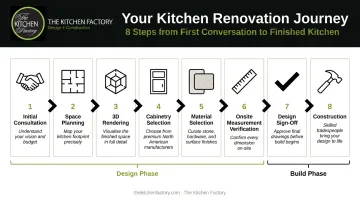
Working with a full-service design firm from concept to completion protects both budget and outcome. When design and construction are managed by the same team, the handoff between phases requires no re-briefing, and the finished kitchen reflects the original vision.
Frequently Asked Questions
What does a luxury kitchen remodel cost?
Luxury kitchen renovations in the Los Angeles area typically start around $150,000 for large kitchens, with costs rising based on custom cabinetry complexity, appliance selections, and stone quality. LA labor and permitting costs consistently exceed national averages. A consultation with an experienced designer will give you a project-specific estimate based on your actual scope.
What color kitchen is in for 2026?
White oak cabinetry, sage green accents, warm greige, and deep navy are all strong directions heading into 2026. Brass hardware pairs naturally with these palettes. That said, timeless material choices like natural stone and stained wood outlast any single color cycle, so build the design around endurance, not the trend.
How long does a luxury kitchen renovation take?
From first design consultation to project completion, a full luxury kitchen renovation typically runs 6–12 months in the LA market. A thorough design phase upfront — covering layout, cabinetry, materials, and appliances before construction begins — prevents the mid-project changes that extend timelines and inflate budgets.
What appliances are considered essential in a luxury kitchen?
A professional-grade range, integrated refrigerator, and quality dishwasher form the core. From there, wine coolers, built-in espresso machines, warming drawers, and steam ovens elevate the kitchen for serious cooks and frequent entertainers. Panel-ready versions of all major appliances create the most cohesive finished look.
What is the difference between custom and semi-custom cabinetry in a luxury kitchen?
Custom cabinetry is built to your exact dimensions, materials, and interior organization requirements — nothing adapted from standard manufacturer sizing. Semi-custom works within preset box sizes with finish and style choices layered on top. Most luxury renovations favor fully custom for precise spatial fit and a genuinely tailored result.
How do I choose between marble and quartz countertops?
Marble offers unmatched natural beauty and unique veining, but it's porous and can etch from acidic substances like lemon juice and stain from wine or coffee. Engineered quartz is non-porous, stain resistant, and never needs sealing. Choose based on your cooking intensity, maintenance preference, and how much you value natural character versus consistent performance.