Introduction
Many homeowners assume a small bathroom footprint rules out a walk-in closet entirely. It doesn't. The real constraint isn't square footage — it's planning. Without the right layout strategy, even a generous space becomes a cramped, poorly lit afterthought. With the right approach, a compact bathroom can accommodate a closet that feels intentional, organized, and luxurious.
The 22 ideas ahead cover everything from layout strategies and smart storage to finishing touches — whether you're renovating a primary suite or reconfiguring an existing bathroom, these ideas meet you where your space is.
Key Takeaways
- A sliding pocket door eliminates door-swing clearance, one of the simplest gains in a tight bathroom footprint
- Floor-to-ceiling vertical shelving and double hanging rods are the most underused storage assets in small closets
- Matching finishes and lighting across bathroom and closet creates a seamless, polished look
- The practical minimum for a functional walk-in is 4–5 feet deep; anything less often works better as a reach-in
- Floor plans alone aren't enough; elevations catch rod heights, switch locations, and window conflicts before construction begins
Before You Start: Key Planning Considerations for Small Bathroom Closets
Dimensions First
Before committing to a walk-in configuration, verify the space can support one. According to Knape & Vogt's closet hardware planning guide, the minimum hanging depth is 1'9", with 24" as the standard. Passage clearance requires at least 2'6", and double-sided hanging needs a minimum 6'6" width.
If the bathroom-adjacent zone can't hold hanging depth plus clear passage, a reach-in or built-in niche is the smarter call.
Door Type Changes Everything
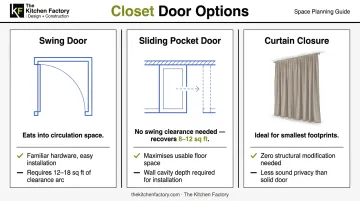
Choose your door type early — it affects how the entire layout functions:
- Swing doors require clear floor arc, which eats into bathroom circulation
- Sliding pocket doors eliminate swing conflict entirely and keep sightlines clean
- Curtain closures work for the smallest footprints and add softness without hardware bulk
NKBA guidelines require a 34" clear opening for doorways. Pocket doors meet this standard. The wall cavity must be confirmed before framing begins, though — a 28" door needs a rough opening of approximately 58" wide.
Why Elevations Matter as Much as Floor Plans
Floor plans show where walls and fixtures land. Elevations show where hanging rods, shelves, light switches, and windows actually sit in three-dimensional space. In a small bathroom-closet project, those vertical relationships determine whether the layout works or creates expensive surprises mid-construction.
That's why working from both documents matters before a single piece of millwork goes into production. The Kitchen Factory's design process includes personalized floor plans, elevations, and 3D renderings — so clients see the full picture well before construction begins.
Layout and Floor Plan Ideas: Making the Space Work
Idea #1: Sliding Pocket Door Walk-In Closet
A pocket door slides into the wall cavity instead of swinging into the room — no arc clearance required on either side. This single decision can recover 8–12 square feet of effective circulation space in a small bathroom. When open, it also creates a clean visual connection between the two spaces, which reads as intentional rather than makeshift.
Idea #2: Closet Tucked Into an Alcove or Nook
Dead-end corridors, irregular wall angles, and unused alcoves adjacent to bathrooms are ideal for conversion. The key test: does the nook have at least 24" of hanging depth and enough width to allow passage? If yes, it can become a proper walk-in with minimal structural intervention.
Idea #3: Recessed Wall Closet Built Inward
Rather than extending the closet into the room, build it into the wall cavity. This works particularly well against non-load-bearing walls or walls adjacent to low-priority spaces like a coat closet or utility area. The floor plan footprint stays the same; the storage depth comes from inside the wall.
Idea #4: L-Shaped Layout Using Two Walls
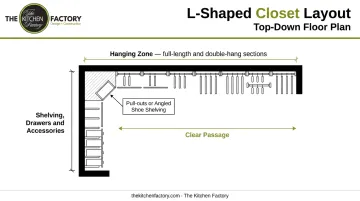
An L-shaped configuration wraps storage across two perpendicular walls, adding a second storage wall without increasing the overall footprint significantly. Compared to a single-wall arrangement, it improves access for two users and creates natural zone separation:
- One wall dedicated to hanging (full-length and double-hang sections)
- One wall for shelving, drawers, and accessories
- Corner junction used for pull-out units or angled shoe shelving
Idea #5: Borrowed Square Footage From an Adjacent Space
Borrowing square footage from an adjacent bedroom — or converting an existing linen closet into a pass-through walk-in — can dramatically improve both the bathroom and the closet without adding square footage to the home. In primary suite remodels, shifting a doorway as little as 26" can open up a far more functional layout.
Before opening any walls, confirm whether they are load-bearing. Non-load-bearing walls can typically be modified without structural reinforcement; load-bearing walls require a header beam and permit work.
Smart Storage Design Ideas: Fitting More Into Less
Idea #6: Floor-to-Ceiling Vertical Shelving
Most closets waste everything above 72 inches. Using the full ceiling height — especially in homes with 9-foot or higher ceilings — adds significant storage without touching the floor plan. Reserve the top zone for seasonal bins and hat boxes. Keep everyday items at eye level. Pull-down rod systems extend accessibility when ceilings go above 9 feet.
Idea #7: Double Hanging Rods
According to Knape & Vogt's planning specifications, the top rod in a double-hang configuration sits at 80–82 inches from the floor; the bottom rod at approximately 40–42 inches. This setup effectively doubles hanging capacity for shorter garments — shirts, folded slacks, jackets — without requiring additional square footage.
Idea #8: Pull-Out Drawers and Slide-Out Hampers
Integrated pull-out drawers and concealed laundry hampers keep the closet floor clear — particularly important when the closet is visible from the bathroom. Key options to consider:
- Slide-out hampers recessed into a cabinet base eliminate the visual clutter of a freestanding basket
- Pull-out drawers at lower cabinet heights keep folded items accessible without stacking
- Divided drawer inserts separate accessories and prevent the drawer from becoming a catch-all
Idea #9: Built-In Dresser or Small Island
A built-in dresser removes the need for separate bedroom furniture, keeping folded clothes and accessories in one dedicated zone. It's a practical upgrade that earns its footprint.
A small island raises the bar further. Clearance requirements are strict: Inspired Closets recommends at least 24" of clear circulation on all sides, while many designers prefer 36". Islands belong in closets with genuinely generous footprints. Treat them as an upgrade, not a default.
Idea #10: Open Shelving With a Labeled Basket System
Open shelves paired with labeled bins or baskets create a boutique-style look that stays functional day-to-day. The key is depth: match shelf depth to what it holds. ClosetMaid's wire shelving specifications range from 6" to 20" deep depending on shelf type — use shallower shelves for accessories and deeper shelves for folded goods.
Idea #11: Under-Bench Storage With Built-In Seat
A built-in bench with drawers or cubbies below serves two purposes: a place to sit while putting on shoes, and concealed storage for footwear, accessories, or folded items. In a narrow closet, a bench along one wall keeps the traffic path clear while making the space feel deliberate rather than improvised.
Style, Lighting, and Finishing Touches: Elevating the Look
Idea #12: Mirrored Doors or Full-Length Mirror
Architectural Digest's small bathroom guidance confirms that mirrors reflect light and patterns to simulate depth, making compact spaces feel considerably larger. In a bathroom closet, mirrored doors eliminate the need for a separate dressing mirror elsewhere — place them opposite a light source for maximum effect.
Idea #13: Cohesive Finishes Between Bathroom and Closet
Treating the bathroom and closet as two separate design projects is one of the most common mistakes in suite renovations. Matching cabinet materials, hardware finishes, lighting temperature, and flooring across both spaces creates a unified, high-end result.
Mismatched finishes — warm brass hardware in the bathroom, chrome pulls in the closet — immediately signals that the closet was added as an afterthought.
The Kitchen Factory's process includes a dedicated cabinetry selection phase and a "Completing the Look" stage where hardware is curated across the entire suite, ensuring nothing reads as disconnected.
Idea #14: Accent and Task Lighting
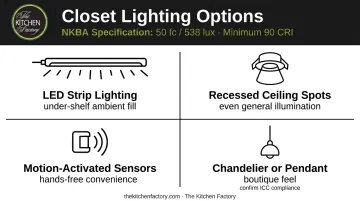
Good closet lighting isn't optional — it's what separates a functional space from a frustrating one. NKBA specifies 50 fc / 538 lux for task illumination and a minimum 90 CRI for accurate color rendering. Options include:
- LED strip lighting under shelves for soft ambient fill
- Recessed ceiling spots for even general illumination
- Motion-activated sensors for hands-free convenience
- A small chandelier or pendant for a boutique feel (note: ICC prohibits pendant light fixtures in clothes closets, so confirm compliance with your electrician)
Idea #15: Glass-Front Cabinetry
Glass-front doors add visual depth to a compact closet, let you see contents at a glance, and contribute to a spa-like or gallery-style aesthetic. Frosted or reeded glass provides the same visual openness with slightly more privacy — ideal for a bathroom-facing cabinet.
Idea #16: Bold Interior Color or Wallpaper
A dramatic paint color or patterned wallpaper on the closet interior makes the space feel like a distinct, designed room rather than a storage afterthought. It can either contrast with the bathroom palette for impact or complement it for flow — both approaches work when the choice is deliberate.
Idea #17: Custom Cabinetry With Coordinated Hardware
Off-the-shelf modular units rarely fit irregular wall shapes, window placements, or the angled ceilings common in older Los Angeles homes. Custom cabinetry — sourced through manufacturers like Eclipse Cabinetry (full-access frameless construction that yields up to 10% more interior space than framed cabinets) or Wood-Mode — addresses those constraints precisely.
Hardware coordination across bathroom and closet, whether brushed nickel, matte black, or unlacquered brass, is what makes the suite read as a single cohesive design.
Idea #18: Curtain Closure for a Soft, Compact Finish
For the smallest closet openings where even a pocket door feels heavy, a quality linen or velvet curtain offers a practical alternative. It requires no wall cavity, installs quickly, and adds softness to the space. The visual weight is lighter than any door — a real advantage when square footage is already at a premium.
Pro Design Considerations: Getting the Most Out of Your Bathroom Closet Space
Designing for Two Users
A closet designed for one person functions completely differently than one shared between two. From the start, plan for:
- Adequate circulation width between hanging sections (minimum 36" when possible)
- Clear zone demarcation — each person's hanging, shelving, and drawer space defined before cabinetry is ordered
- Storage allocation that reflects how each person actually gets ready, not just equal halves
Getting this right before fabrication begins saves real cost and frustration later.
Common Mistakes — and How to Avoid Them
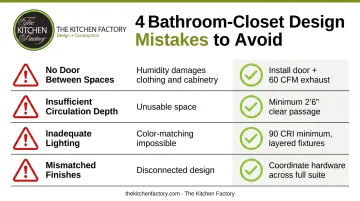
The most expensive bathroom-closet mistakes tend to be the most preventable:
- No door between spaces — humidity from showers damages clothing and wood cabinetry over time; NKBA recommends 60 CFM exhaust for bathrooms, and walk-in closets attached to showers need additional ventilation
- Insufficient circulation depth — a closet that can't be comfortably used defeats the purpose
- Inadequate lighting — under-lit closets make color-matching impossible
- Mismatched finishes — the surest sign of a disconnected design process
The Kitchen Factory has worked through bathroom and closet projects across greater Los Angeles for over 30 years. Every project runs through floor plans, elevations, 3D renderings, and onsite measurement verification before any millwork is produced.
When to Invest in Full-Service Design
For luxury bathroom-closet combinations involving custom cabinetry, coordinated finishes, and integrated lighting, a full-service process from concept through completion ensures everything works together. These decisions don't live in isolation:
- Floor plan choices determine which elevation configurations are even possible
- Material selections drive lighting temperature and fixture type
- Managing those calls across separate vendors — designer here, contractor there — is where costly mistakes happen
Frequently Asked Questions
Is it okay to have a walk-in closet in the bathroom?
Yes — bathroom-adjacent walk-in closets are a hallmark of well-designed primary suites. The keys to making it work: a door between spaces, adequate exhaust ventilation to protect clothing and cabinetry, and humidity-resistant materials where moisture is a factor.
What is the best layout for a small bathroom?
Single-wall and L-shaped layouts are the most space-efficient for small bathrooms. Integrating a closet at one end of an L-shaped plan can improve overall suite flow while consolidating the morning routine in a logical sequence.
What makes a bathroom look tacky according to designers?
Mismatched finishes, poor lighting, exposed clutter, and cheap hardware top the list. A closet that looks like an afterthought — rather than an intentional part of the suite — is among the most common complaints designers cite.
What is the hottest bathroom trend in 2026?
The NKBA's 2026 Bath Trends Report points to larger bath footprints built around wellness, universal design, and efficient storage. Bathroom-closet suites designed as unified dressing rooms, spa-inspired minimalism, and integrated smart lighting are leading the shift.
What is the minimum size for a walk-in closet in a small bathroom?
A functional single-user walk-in needs at least 24" of hanging depth and 2'6" of clear passage. In practical terms, that typically means a minimum footprint of around 4 feet deep by 4–5 feet wide — anything smaller works better as a reach-in.
How can I make a small bathroom closet look bigger?
Mirrored doors, consistent light finishes, high-CRI lighting, and open shelving at eye level all help. The most important rule: avoid over-filling the space. A well-edited closet with good lighting reads as intentional; a packed one reads as cramped regardless of actual size.