Introduction
Hiring a local contractor for custom kitchen cabinets is one of the most consequential decisions in any home renovation. Get it wrong, and you're looking at poor craftsmanship, blown budgets, and a kitchen that works against you instead of for you.
Los Angeles makes this harder than it sounds. The market runs the full spectrum — from skilled design-build firms with decades of local experience to general handymen who underquote jobs they're not equipped to finish. Without a clear framework, the sorting process costs you time, money, and sometimes both.
This guide breaks down the comparison process into specific, concrete factors: what to look for, what to ask before you sign, and how to read the signals contractors give you during the sales process.
Key Takeaways
- Price alone is a poor predictor of project quality — experience, portfolio depth, and communication style matter just as much
- Custom cabinets require design fluency, not just installation skill — a general installer and a design-build firm are not interchangeable
- In California, any contractor performing work valued at $500 or more must hold a valid CSLB license — verify before signing
- Trustworthy contractors provide itemized written quotes and clear change-order policies — vague lump-sum estimates are a red flag
- The right contractor asks how you live and cook, not just what finish you want
What Does a Local Kitchen Cabinet Contractor Actually Do?
Not all contractors who "do cabinets" are doing the same work. The distinction matters more than most homeowners expect for custom projects.
Three Contractor Types You'll Encounter
| Contractor Type | What They Do | Best Suited For |
|---|---|---|
| Cabinet Installer | Fits prefabricated or ordered boxes; limited design involvement | Simple replacements, stock or semi-custom cabinets |
| General Remodeling Contractor | Manages broader kitchen work including cabinets as one component | Full kitchen renovations involving multiple trades |
| Design-Build Firm | Handles layout planning, material selection, fabrication coordination, installation, and finishing as an integrated process | Fully custom kitchens, non-standard layouts, luxury projects |
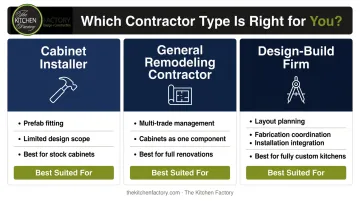
Under California's CSLB classification system, cabinet and millwork work falls under the C-6 license (Cabinet, Millwork and Finish Carpentry), while kitchen remodels involving multiple trades — plumbing, electrical, framing — require a Class B General Building or B-2 Residential Remodeling license.
When to Hire a Specialist vs. a Generalist
For straightforward replacements with standard dimensions, a qualified installer may be sufficient. But if your project involves any of the following, you need a contractor who can solve spatial problems — not just measure and order:
- Non-standard or asymmetrical layouts
- Built-in appliances requiring custom framing
- Full kitchen reconfiguration across multiple trades
- High-end or specialty materials with complex tolerances
That difference shows up early. A design-build firm spends time understanding how you actually use your kitchen before drawing a single line. An installer measures the space and asks what you've already decided.
What to Look For When Comparing Local Contractors
Comparing on price alone is a common and costly mistake. Here are the factors that actually predict project quality.
Experience and Local Market Knowledge
Years in business matter, but so does the type of experience. A contractor who has worked extensively in Los Angeles understands the architectural variety here — everything from hillside mid-century homes with awkward sight lines to open-plan Bel Air estates where the kitchen anchors the entire ground floor.
Ask specifically about comparable past projects. General renovation experience is less relevant than demonstrated work in luxury kitchens or high-end residential remodels at a similar scale to yours.
Portfolio and Design Aesthetic
A portfolio tells you more than any sales pitch. Look for:
- Consistency in quality across multiple projects, not just one hero shot
- Range in style — can they execute both contemporary and traditional designs convincingly?
- 3D renderings or design drawings, which indicate a process that catches layout problems before installation begins, not during it
The Kitchen Factory, for example, provides detailed 3D renderings during Phase 2 of their design process — before any material is ordered — so clients can evaluate every decision visually and make revisions without cost consequences.
Licensing, Insurance, and Credentials
California requires a licensed contractor for any kitchen remodeling work valued at $500 or more in labor and materials. The CSLB's online license-check tool lets you verify any contractor's license status in minutes — use it before the first serious conversation.
Workers' compensation is required when a contractor has employees. General liability insurance is not legally mandated by California, but CSLB strongly recommends it, and contractors must disclose whether they carry it. Always request certificates before work begins.
One more number worth knowing: CSLB estimates that unlicensed contracting contributes to an underground economy of $60 billion to $140 billion annually, with tens of thousands of operators violating licensing laws daily. An unusually low bid is often the first sign you're talking to one of them.
Customization Capability and Cabinet Types Offered
The cabinet spectrum runs from stock (off-the-shelf sizes, limited styles) to semi-custom (factory-built to order within a defined catalog) to fully custom (no catalog constraints, any dimension, any finish). Which options a contractor can actually offer depends entirely on their manufacturer relationships.
Contractors partnered with established manufacturers can offer better materials, more finish options, and functional upgrades. When evaluating luxury custom cabinets, ask specifically about construction methods:
- Plywood box construction vs. particleboard
- Dovetail drawer joinery
- Full-access frameless construction
- Soft-close hardware standards
These aren't just premium features — they're durability indicators. KCMA's A161.1-2022 standard requires certified cabinets to withstand 600 lb wall-cabinet loading and 25,000 door and drawer cycles.
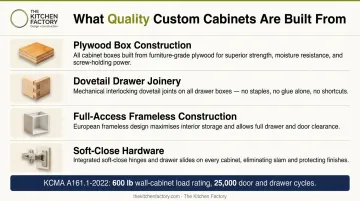
A contractor who can speak to these specs knowledgeably is sourcing at that level; one who can't probably isn't.
For reference, The Kitchen Factory works with four North American manufacturers — Cabinets by ZePHYR, Columbia Cabinets, Eclipse Cabinetry, and Wood-Mode — each in business since at least the 1970s. Wood-Mode operates without a fixed catalog, so designers can build elements specific to each kitchen rather than adapting to predefined sizes.
Transparency in Pricing and Process
California law requires written contracts for home improvement projects over $500, with detailed progress-payment schedules and written, signed change orders for any scope changes. CSLB also caps contractor down payments at 10% of the contract price or $1,000, whichever is less.
Beyond legal requirements, watch for these signals when comparing quotes:
- Quotes that separate labor, materials, hardware, and subcontracted work are a sign of a transparent operation
- Vague lump-sum estimates with no cost breakdown deserve a follow-up question before you proceed
- No written change-order policy is a financial risk that compounds as the project grows
The FTC advises against automatically choosing the lowest bidder and recommends asking for explanations when estimates differ significantly — because they usually differ for a reason.
Communication Style and Project Management
How a contractor communicates during the sales process is a reliable preview of how they'll communicate once your kitchen is torn apart. Contractors who respond promptly, ask detailed questions about how you cook and entertain, and explain tradeoffs clearly are demonstrating habits that will carry through to installation.
Before signing, ask:
- How are project updates delivered, and how frequently?
- Who is my primary point of contact throughout the project?
- How do you handle unexpected delays or scheduling conflicts?
Vague or defensive answers to these questions at the proposal stage tend to become expensive problems once demolition starts.
Questions to Ask Before You Sign
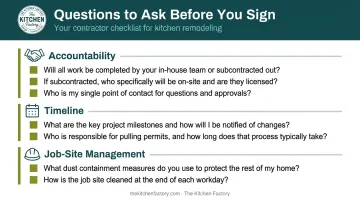
Reputable contractors answer these questions clearly and without defensiveness. Hesitation or vagueness tells you something useful about how they'll handle problems once the project starts.
Who handles design, fabrication coordination, and installation — in-house or subcontracted?
Subcontracting isn't automatically a problem, but fragmented accountability is. You need to know who is responsible if something goes wrong and how disputes between parties are resolved. Ask directly:
- Who is your single point of contact from design through installation?
- If a fabrication error occurs, who owns the fix — you or the sub?
- How are scheduling conflicts between your trades handled?
Firms like The Kitchen Factory manage design, sourcing, and installation coordination under one roof, which removes the ambiguity entirely.
What is the realistic project timeline, and what milestones should I expect?
A contractor who can't give you a timeline range isn't sufficiently organized. In Los Angeles, permitting can affect timelines: the LADBS PermitLA process allows combined permits for cabinet replacements without structural changes. Any structural modifications require plan sets and a plan check, adding steps to the schedule. Get a written milestone schedule, not a verbal estimate.
How do you handle dust containment, job-site cleanliness, and access during the project?
In luxury homes, job-site management matters as much as craftsmanship. Ask specifically about dust barriers, daily cleanup expectations, and how the contractor protects adjacent flooring, surfaces, and finishes. If the answer is vague, ask for a reference from a previous client in a comparable home — experienced high-end contractors have a clear protocol and can back it up.
How The Kitchen Factory Can Help
The Kitchen Factory is a family-owned, full-service luxury kitchen design firm with over 30 years of experience serving homeowners across the greater Los Angeles area — from Studio City and Bel Air to Burbank, Redondo Beach, Long Beach, and beyond. Their designs have been featured in Architectural Digest, and their clientele includes entertainment figures, sports professionals, and Fortune 500 executives.
Beyond their track record, the firm brings a distinctive design philosophy. Owner Dennis McAllister builds every kitchen around the act of cooking — producing spaces that are as functional as they are visually distinctive. Senior Designer David Miller approaches each project with equal conviction: the kitchen is where relationships are built, friendships deepen, and daily life unfolds. Both perspectives drive every decision from layout to cabinet selection.
Key differentiators worth weighing:
- 30+ years of local market experience across the full range of LA's architectural contexts
- Manufacturer partnerships with Cabinets by ZePHYR, Columbia Cabinets, Eclipse Cabinetry, and Wood-Mode — each with decades of proven craftsmanship
- Full-service process from initial design consultation and 3D renderings through final installation, with a single point of accountability
- Fixed-cost remodeling agreements that minimize surprise expenses
- Design built to last, not trend-driven — critical for a kitchen that needs to look and perform well for 20-plus years
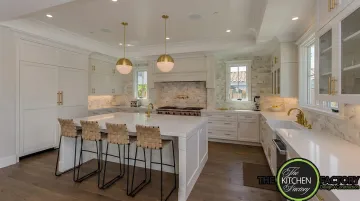
For homeowners ready to move past comparisons and start planning, The Kitchen Factory offers in-person consultations at their showroom at 12610 Ventura Blvd, Studio City, CA 91604. Call 818.505.1546 to schedule.
Conclusion
Choosing the right contractor for custom kitchen cabinets comes down to more than price. Experience, design capability, material knowledge, process transparency, and communication quality all shape the outcome — and together, they determine whether your finished kitchen genuinely reflects how you live or simply fills the space.
The kitchen is among the most personal, high-use rooms in any home. The contractor you choose will shape how that space performs and feels for years. Taking the time to evaluate properly — asking hard questions, verifying credentials, comparing itemized quotes — pays off long after the last cabinet door is hung. If you're in the Los Angeles area and want to work with a team that has handled this process for over 30 years, The Kitchen Factory offers full-service design consultations from their Studio City showroom.
Frequently Asked Questions
How much should a contractor charge to install cabinets?
According to HomeAdvisor's 2025 data, custom cabinets average $7,427 nationally, with a typical range of $2,798 to $12,934 ($500–$1,200 per linear foot depending on material and complexity). Los Angeles labor rates trend higher than those averages. Itemized quotes are the only reliable way to evaluate whether a specific price is fair.
What is the difference between a cabinet installer and a kitchen design-build firm?
A cabinet installer fits prefabricated or ordered boxes — their role starts once design decisions are finalized. A design-build firm manages layout planning, material selection, fabrication coordination, and installation as one integrated process. For fully custom kitchen projects, a design-build firm is the appropriate choice.
How long does a custom kitchen cabinet project typically take in Los Angeles?
Timelines vary based on scope, material lead times, and whether permits are required. Simple cabinet replacements without structural changes may qualify for streamlined LADBS permits; structural modifications add plan-check steps. Ask your contractor for a written schedule with milestones — verbal estimates are too vague to be useful.
Do I need a licensed contractor for kitchen cabinet installation in California?
Yes. California requires a licensed contractor for any work valued at $500 or more in labor and materials. Relevant CSLB license classes include C-6 (Cabinet, Millwork and Finish Carpentry) for cabinet-specific work, and B or B-2 for broader kitchen remodels involving multiple trades. Verify status at cslb.ca.gov before signing any contract.
What questions should I ask a contractor before hiring them for custom cabinets?
Ask these before signing anything:
- Who handles each phase — in-house or subcontracted?
- What is the realistic timeline, with written milestones?
- How are change orders priced and approved?
- Which manufacturers do you work with, and why?
A contractor who answers these directly — without vague deflection — is worth a second conversation.
How do I know if a contractor's cabinet quote is fair?
Request itemized quotes that separate labor, materials, hardware, and any subcontracted work. Vague lump-sum estimates make it impossible to evaluate cost drivers. Get at least two to three comparable quotes — and remember that the lowest price often reflects lower-grade materials, inferior hardware, or exclusions that reappear as change orders later.