
One Kitchen Factory client in Tarzana spent $80,000 renovating their kitchen and recouped 100% of that investment at sale. That outcome wasn't accidental. It came from understanding where remodel dollars actually generate returns versus where they disappear into upgrades buyers can't distinguish — or don't value enough to pay a premium for.
In today's market, the data is clear: targeted, scope-controlled upgrades consistently outperform gut renovations on ROI percentage. Knowing the difference before you commit can mean tens of thousands of dollars at resale.
Key Takeaways
- Minor kitchen remodels recover 112.9% of their cost nationally — and 129.1% in the Pacific region — outperforming full gut renovations by a wide margin
- High-visibility surfaces (cabinets, countertops, appliances) drive the strongest returns; structural and ultra-custom changes rarely recoup their cost
- The 5–15% rule is a useful guardrail for scoping kitchen spend, but pair it with actual ROI data rather than treating it as an authoritative standard
- In the LA luxury market, buyers expect quality and cohesion; timeless, neutral designs sell faster and at stronger prices than trend-driven ones
- Engaging a design firm before finalizing scope is the most reliable way to avoid over-improvement
What the Data Actually Says About Kitchen Remodel ROI
Kitchen remodel ROI isn't a single number. It shifts depending on project scope, geography, and execution quality. The most reliable data source is the 2025 Cost vs. Value Report from JLC/Zonda, which tracks remodeling costs against resale value across 119 U.S. markets.
The Three Project Tiers
| Kitchen Tier | Job Cost | Resale Value Added | Cost Recouped |
|---|---|---|---|
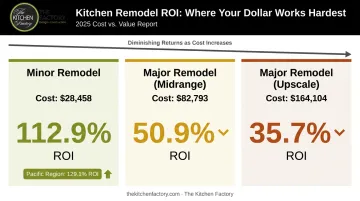
| Minor remodel (midrange) | $28,458 | $32,141 | 112.9% |
| Major remodel (midrange) | $82,793 | $42,130 | 50.9% |
| Major remodel (upscale) | $164,104 | $58,561 | 35.7% |
The counterintuitive finding: the least expensive project tier produces the highest return percentage — by a significant margin.
The minor tier keeps cabinet boxes and the existing layout intact, replacing only visible surfaces: door fronts, hardware, countertops, one or two appliances, sink, faucet, flooring, and paint.
The upscale tier adds custom cabinetry, commercial-grade appliances, imported stone, and designer fixtures. Those costs escalate faster than buyers are willing to pay a premium for — which is why the numbers gap widens so sharply between tiers.
The Pacific Region Advantage
For LA-area homeowners, the regional numbers are even more favorable:
| Kitchen Tier | Pacific Region Cost Recouped |
|---|---|
| Minor remodel | 129.1% |
| Major remodel (midrange) | 57.2% |
| Major remodel (upscale) | 38.8% |
The Pacific region — the closest available proxy for California — outperforms national averages across all three tiers. For LA homeowners, this data makes a concrete case for rightsizing the project rather than over-building it.
Three Types of ROI Worth Tracking
Most homeowners focus on resale ROI — what they recoup at closing. The data above captures that dimension well. Two other types round out the picture:
- Lifestyle ROI: Daily quality-of-life improvement for however long you live in the home
- Risk-reduction ROI: Preventing deferred maintenance issues that would surface in a buyer inspection
The smartest remodels account for all three. A kitchen that functions beautifully, photographs well, and surfaces no red flags during inspection delivers on all three — without requiring an upscale budget to do it.
High-Return Kitchen Upgrades Worth the Investment
Buyers form their first impression of a kitchen in roughly 30 seconds. That impression is almost entirely driven by what they see and touch — cabinet faces, countertop surfaces, appliances, lighting. Upgrades to these visible elements deliver disproportionate return because they control perception without requiring expensive structural or layout changes.
Cabinets: The Highest-Visibility Investment
Cabinet updates consistently deliver the strongest returns of any kitchen upgrade. The logic from the Cost vs. Value data is instructive: the minor remodel tier — which keeps existing cabinet boxes and replaces only doors, drawer fronts, and hardware — recoups 112.9% nationally. The major tier, which replaces cabinet boxes entirely, recoups 50.9%.
That gap makes the refacing-versus-replacement decision financially significant:
- Cabinet refacing (new doors, drawer fronts, hardware; existing boxes stay): Angi estimates $900–$6,000 depending on scope. No isolated ROI benchmark exists for refacing alone, but the minor remodel tier's strong performance points to this as the cost-controlled path to preserving return
- Full cabinet replacement: HomeAdvisor estimates average costs around $5,050–$6,700. Warranted when boxes are damaged, outdated beyond cosmetic repair, or when a layout reconfiguration is genuinely necessary
On style: timeless door profiles — shaker being the most enduring example — maintain broad buyer appeal across price points and design preferences. At The Kitchen Factory, which has been designing kitchens in the LA market for over 30 years, the consistent principle is that classic profiles outlast trends and resell to a wider buyer pool. The firm sources cabinetry from manufacturers including Wood-Mode, Eclipse Cabinetry, Columbia Cabinets, and Cabinets by ZePHYR. Together, those lines cover more than 400 styles across contemporary and traditional profiles.
Countertops: The Visual Anchor
Countertops define the aesthetic mood of a kitchen. NKBA's 2024 Kitchen Trends report found quartz leading countertop material preferences at 73%, versus granite at 23%. NKBA's 2026 report placed quartz first again, with natural quartzite close behind.
Buyers respond to quartz because it requires almost no maintenance and holds up to daily use. For a resale-focused remodel, that reliability translates directly to buyer confidence. Premium exotic stones can be striking, but narrower appeal and higher upkeep give some buyers pause.
The Kitchen Factory works with quartz brands including Caesarstone, Cambria, PentalQuartz, and Silestone, alongside natural stone options for clients where that aesthetic is right for the home.
Appliances and Fixtures: Functional Signals
Updated appliances communicate one thing to buyers: the kitchen was maintained and modernized. The JLC minor remodel tier (which recoups 112.9% nationally) includes replacing the range and refrigerator with current energy-efficient models. It does not include commercial-grade or professional appliance suites.
Mid-grade appliances signal modernity without the cost premium that buyers rarely pay back proportionally.
Fixtures follow the same logic. Angi puts professional kitchen faucet installation at $162–$364. At that price point, a visual upgrade to a well-designed undermount sink and clean-lined faucet delivers outsized aesthetic impact.
Lighting and Paint: Maximum Impact, Minimum Cost
Layered lighting (ambient overhead, task lighting at work surfaces, and accent lighting in upper cabinets) transforms how a kitchen reads in person and in listing photos. The JLC upscale tier includes low-voltage undercabinets and general/task fixtures; even simplified versions of this approach improve perceived size and quality .
Paint is the most overlooked high-return upgrade in kitchen remodeling. The JLC minor tier includes painting walls, trim, and ceiling as part of its scope. Zillow's 2025 paint analysis found that specific kitchen cabinet colors — dark olive green, graphite islands — were associated with measurable sale price increases of $1,600–$2,512. A neutral, professionally executed paint refresh costs a fraction of any structural change and consistently improves buyer response.
Upgrades That Rarely Pay Off
Professional-Grade Appliances
The upscale major remodel tier — which includes a built-in refrigerator, commercial-grade cooktop, vent hood, and wall oven — recoups only 35.7% nationally in the 2025 JLC data. That's the full project scope, but the appliance package is a meaningful cost driver.
Most buyers can't tell the difference between a high-quality conventional appliance and a professional-grade one during a walkthrough. Those who do notice often view specialized maintenance as a liability. Zillow listing data shows some price association with chef-oriented features, but that reflects marketing positioning — not proportional cost recovery.
Highly Personalized Design
Bold color schemes, intricate mosaic backsplashes, and dramatic custom cabinetry in unusual finishes narrow the buyer pool. A kitchen that perfectly expresses one homeowner's taste will resonate with some buyers and actively deter others. The math on days-on-market tends to favor neutrality.
NAR notes that sellers with dated or highly personalized kitchens typically need to price downward when competing against updated homes. The conclusion holds across multiple data sources: neutral, cohesive kitchens sell faster and at stronger prices.
The Invisible Investment Trap
Personalized aesthetics aren't the only ROI trap. Structural changes — the kind hidden behind walls — carry the same problem: buyers can't see them and won't pay a premium for them.
Common invisible investments include:
- Moving plumbing or relocating drain lines
- Removing or relocating load-bearing walls
- Rewiring electrical panels or adding circuits
These changes inflate project budgets without delivering proportional resale value. The JLC data reflects this indirectly — the minor remodel tier avoids all of them, and its ROI dramatically outperforms the tiers that include structural work.
Smart Budget Rules Every Homeowner Should Know
The 5–15% Rule
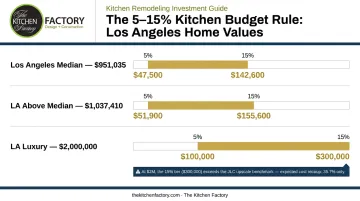
A common industry guardrail puts kitchen remodel spending at 5–15% of the home's total value. No single authoritative body — NAR, JLC, or NKBA — has codified this as a formal standard, but as a starting benchmark, it holds up in practice.
For LA-area homeowners, the dollar math shifts considerably:
| Home Value | 5% Budget | 15% Budget |
|---|---|---|
| $951,035 (LA avg, Zillow 2026) | ~$47,500 | ~$142,600 |
| $1,037,410 (LA SFR median, April 2026) | ~$51,900 | ~$155,600 |
| $2,000,000 | ~$100,000 | ~$300,000 |
Note that at $2M+, a 15% budget exceeds the JLC national upscale kitchen benchmark of $164,104 — and that benchmark recoups only 35.7%. The percentage rule must be paired with ROI data, not used in place of it.
Matching Neighborhood Standards
Over-improving relative to neighborhood comparables is one of the most common and costly mistakes in residential remodeling. A $200,000 kitchen in a street of $800,000 homes creates a loss, not a gain — buyers in that neighborhood have a price ceiling, and no single room will push them past it.
The underlying principle is conformity. Homes perform best when improvements match or slightly exceed nearby comparables:
- Appraisers apply this concept directly when assessing value
- Buyers apply it intuitively when deciding what a home is worth to them
- Sellers who ignore it often absorb the overage at closing
Why Early Planning Matters
Knowing your neighborhood's ceiling is only useful if you act on it before committing to a budget. The most reliable way to avoid over-improvement is to define scope before spending — and that means getting professional guidance while options are still open, not after a design has already taken shape.
An experienced design firm helps establish what the market will support in your specific neighborhood before decisions are finalized.
The Kitchen Factory starts every project with budget and layout planning before materials are selected or construction begins. A fixed-cost remodeling agreement means clients know exactly what they're committing to from day one. That upfront clarity — not mid-project adjustments — is what determines the financial outcome.
The LA Luxury Market Difference
National ROI averages are useful benchmarks, but the Los Angeles market operates differently. Median single-family home prices in LA hit $1,037,410 in April 2026, according to Greater Los Angeles Realtors. At that value level, kitchen quality isn't a secondary consideration for buyers — it's a primary purchase driver.
The Pacific region data supports a meaningful regional premium:
- Minor kitchen remodels in the Pacific region recover 129.1% of cost
- The national average sits at 112.9%
That gap reflects higher home values and buyers with higher aesthetic expectations.
NAR characterizes luxury buyers as looking for "restaurant-worthy kitchens" alongside other premium home features. At the $2M+ price point, "updated" isn't enough — buyers expect quality materials, cohesive design, and layouts that function as well as they look.
The specific risk for luxury LA homeowners is spending on bespoke features that appeal only to a narrow buyer profile. A kitchen designed around one person's cooking habits, aesthetic preferences, or specialty appliance choices may be extraordinary to live in but limiting to sell.
The Kitchen Factory's design philosophy — timeless, classic, and trend-proof — is built for exactly this tension. The kitchens that sell fastest and at the strongest prices are sophisticated without being polarizing.
Frequently Asked Questions
What is the average ROI for a kitchen remodel?
ROI ranges significantly by scope. Minor remodels recover 112.9% nationally and 129.1% in the Pacific region per the 2025 JLC data. Major and upscale remodels drop to 50.9% and 35.7%, respectively. Local market conditions shift these figures further, so minor, scope-controlled projects consistently deliver the strongest percentage returns.
What is the 30% rule in remodeling?
The 30% rule is a general guideline suggesting no single room's remodel should exceed 30% of the home's total value. It's designed to prevent over-improvement relative to what the property can support at resale. Like the 5–15% kitchen rule, it's a useful planning guardrail but not an authoritatively sourced standard.
How much remodeling can be done with $100,000?
A $100,000 budget typically covers a comprehensive midrange-to-upper kitchen remodel: new cabinet fronts or semi-custom cabinetry, upgraded countertops, appliance replacements, and updated fixtures and lighting. In a high-value LA home, this often represents a targeted investment that delivers strong ROI rather than a full gut renovation.
Does a kitchen remodel add value to your home before selling?
Yes. Minor, well-executed updates consistently increase home value and reduce time on market, often recovering their full cost or more. NAR's 2025 data found 48% of Realtors reporting increased buyer demand for kitchen upgrades and 30% recommending a kitchen remodel before listing.
What kitchen upgrades have the highest ROI?
The consistently strongest-returning upgrades are cabinet updates (refacing or replacement of fronts and hardware), countertop upgrades to quartz or comparable materials, appliance modernization to current mid-grade models, and lighting and paint refreshes. Buyers notice these elements immediately — which is why they move the needle at resale without requiring structural work.
How does the LA housing market affect kitchen remodel ROI?
The Pacific region — the closest data proxy for California — shows kitchen remodel recoup rates above national averages across all project tiers. In the LA luxury market specifically, buyers at higher price points have elevated aesthetic expectations, making quality, timeless kitchen design a direct factor in both final sale price and how quickly a property moves.