This matters more for luxury kitchen renovations than for simple refreshes. Higher budgets, more complex coordination, custom cabinetry lead times, structural changes — every layer of complexity is another place where miscommunication between separate teams can cost you.
This guide breaks down both models clearly, compares their real-world strengths and weaknesses, and offers a practical framework for deciding which fits your project.
Key Takeaways
- Design-build means one firm, one contract, and one team managing design and construction together
- Traditional contracting requires you to hire a designer separately, then solicit bids from builders — putting you in the coordinating role
- Design-build typically reduces cost surprises and delays on complex, high-budget projects
- Traditional contracting works well when you have finalized plans and want competitive bids
- The right choice depends on project complexity, your time, and how much hands-on coordination you're willing to manage
Design-Build vs. Traditional Contractor: Quick Comparison
| Factor | Design-Build | Traditional (Design-Bid-Build) |
|---|---|---|
| Project Timeline | Faster — design and preconstruction overlap | Slower — full design must be complete before bids go out |
| Budget Accuracy | Higher — construction costs priced during design | Lower — contractor had no input on design decisions |
| Communication | Single point of contact throughout | Homeowner coordinates between designer and contractor |
| Accountability | One firm owns design and execution | Disputes can fall between two separate parties |
| Design Flexibility | Strong — but decisions front-loaded | High creative freedom; designer works independently |
| Best For | Complex, high-budget, or custom renovations | Simpler projects with locked-in plans |
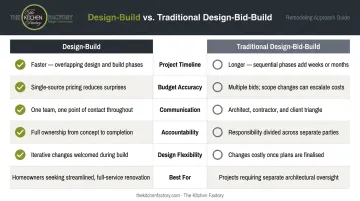
Note: These reflect general tendencies. Individual firms, project variables, and local markets all affect real-world outcomes.
What Is a Design-Build Firm?
The Design-Build Institute of America defines design-build by its single contract for both design and construction — the fundamental difference from every other project delivery model. One firm, one agreement, one integrated team managing concept through completion.
In practice, this means the designer and builder work together from day one. Material choices, layout decisions, and budget trade-offs are made collaboratively — not after plans are handed off to a separate contractor who then finds problems.
Four Core Advantages
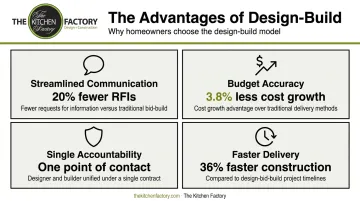
Streamlined communication — Design and construction expertise sit inside the same team, so there's no relay race of information between separate firms. Decisions happen faster and with full context on both sides.
Budget accuracy — Design-build teams price out the construction implications of design decisions as they're made, not six months later when bids come back. A 2018 study by the Construction Industry Institute and Charles Pankow Foundation found that design-build projects experienced 3.8% less cost growth than design-bid-build projects across 212 U.S. building projects.
Single accountability — When one team owns both design and execution, there's nowhere to hide. If a specification error causes a problem, the firm that made the spec also manages the fix — no disputes over accountability between separate parties.
Faster delivery — Preconstruction planning can proceed while design is being finalized, compressing the overall timeline. The same CII/Pankow study found design-build projects were 36% faster in construction speed than design-bid-build. That data covers commercial building projects, not residential kitchens — but the principle holds: eliminating the handoff gap between design and construction removes weeks from most project schedules.
What Does This Look Like in Practice?
A well-run design-build firm moves through each phase without ever passing the baton to an outside team. At The Kitchen Factory — a full-service design firm in Studio City serving greater Los Angeles for over 30 years — the process runs through eight defined phases: vision consultation, space planning with 3D renderings, cabinetry selection, onsite measurement verification, design sign-off, delivery and installation coordination, styling, and post-completion support. Every phase is handled by the same team under one fixed-cost agreement.
That continuity has a practical payoff: material orders are placed at the right time, and very few decisions are left unresolved when construction starts.
Two Real Drawbacks Worth Knowing
- No competitive bids. Committing to one firm for both design and construction means you won't receive competing construction quotes. Some clients value that check-and-balance mechanism.
- Front-loaded decisions. Design-build requires that most decisions be finalized before construction begins. Clients who prefer flexibility mid-project may find the structured process constraining — and late changes can be expensive.
What Is a Traditional Contractor (Design-Bid-Build)?
According to the AIA's primer on project delivery methods, the traditional design-bid-build model follows a linear sequence: the homeowner hires a designer independently to produce complete plans, solicits bids from general contractors based on those documents, and awards a construction contract to the chosen bidder.
The homeowner sits at the center of this model — coordinating between two separate professional relationships.
Where Traditional Contracting Works Well
- Competitive bids drive pricing. When plans are fully documented, multiple contractors can bid against one another. For homeowners with locked-in designs, this can produce real pricing leverage.
- Design independence. Your designer works without construction-side constraints. If you have an existing relationship with an architect whose work you trust, this model preserves that creative partnership.
- Familiar process. Banks, insurers, and real estate professionals know this model well. For straightforward projects, it's easier to navigate financing, contracts, and permitting expectations.
Where It Creates Problems
- The coordination burden falls on you. Managing the relationship between a designer who drew the plans and a contractor who must execute them is the homeowner's job. When disputes arise over intent, errors, or timeline, you're the one in the middle — without professional leverage to resolve them efficiently.
- Budget overruns are more common. Because the contractor had no input during design, surprises surface during construction. Houzz's 2026 renovation study found that 37% of renovating homeowners exceeded their initial budget — with scope expansion and material upgrades as the leading causes. Both are more controllable when design and construction planning happen together.
- No clean accountability mechanism. When two separate firms are involved, disputes over who caused a problem — and who pays to fix it — have no clear resolution. The homeowner absorbs the friction.
That friction is what the design-build model is built to eliminate.
Which Approach Is Right for Your Kitchen Remodel?
The answer depends on three factors: project complexity, your bandwidth for coordination, and how much design-construction integration matters to your outcome.
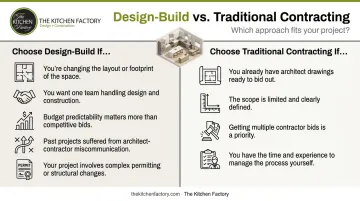
Use This as a Quick Decision Guide
Choose design-build if:
- You're undertaking a full kitchen layout reconfiguration, structural changes, or custom cabinetry specification
- You want a single point of contact from first concept through final installation
- Budget predictability matters more to you than competitive bidding
- You've had frustrating experiences coordinating between separate design and construction teams
- Your project involves complex permitting or long material lead times
Choose traditional contracting if:
- You already have a trusted architect with fully finalized, documented plans
- The project scope is limited — replacing surfaces, updating fixtures, refreshing without structural changes
- You prefer competitive bidding as a cost-control mechanism
- You have the time and expertise to manage the designer-contractor relationship yourself
Kitchens Specifically Favor Design-Build
Kitchens are among the most technically complex rooms to remodel, requiring coordination across plumbing, electrical, structural work, cabinetry specification, appliance placement, and finish material sequencing. That complexity compounds over time. According to Houzz's 2024 renovation data, kitchen renovations averaged 9.6 months of planning and 5.1 months of construction — the longest planning-to-completion timeline of any interior room project.
In the Los Angeles market, the stakes are higher still. JLC's 2025 Cost vs. Value report puts a major upscale kitchen remodel in Los Angeles at a $171,369 job cost — a figure where miscommunication between a separate designer and contractor carries real financial consequences.
At that investment level, the margin for misalignment is thin. For homeowners in the greater Los Angeles area, The Kitchen Factory's design-to-completion model addresses exactly this: concept through construction handled by one team, with cabinetry sourced from premium North American manufacturers, 3D design visualization before materials are ordered, and fixed-cost agreements that hold through completion.
Conclusion
Neither model is universally better. Traditional contracting works for simpler projects with existing plans and homeowners who want competitive pricing. Design-build earns its place on complex renovations where integration, accountability, and budget predictability matter more than bidding flexibility.
For a luxury kitchen renovation involving custom cabinetry, layout changes, and finishes that need to work together cohesively, the integrated approach tends to produce better outcomes. The advantage isn't purely aesthetic — it's that fewer things fall through the gap between what's designed and what actually gets built.
If you're planning a kitchen renovation in the Los Angeles area and want to understand which approach fits your project, The Kitchen Factory offers free design consultations at their Studio City showroom. Reach them at 818.505.1546 to discuss scope, timeline, and what a design-to-completion partnership actually looks like for your home.
Frequently Asked Questions
Is design-build more expensive than hiring a general contractor?
Design-build quotes often appear higher upfront because design and construction costs are bundled together. In practice, the integrated process frequently reduces total project cost — eliminating change orders, coordination gaps, and budget surprises that arise when separate firms hand off responsibility mid-project.
Can I still get a fully customized kitchen with a design-build firm?
Yes. Design-build firms specializing in luxury renovations offer extensive customization. Because the designer and builder collaborate from the start, custom specifications are priced accurately and executed with fewer surprises than when a contractor inherits plans they had no hand in developing.
What happens if I want to make changes mid-project?
Changes are possible in both models, but handled differently. Design-build firms process requests through a single point of contact; in traditional setups, changes require separate renegotiation with both your designer and contractor, which adds time and cost.
What should I look for when vetting a design-build firm?
Start with the portfolio — evaluate construction execution, not just aesthetics. Then confirm:
- References from clients on projects of similar scale
- Active licensing and insurance
- Demonstrated experience in your specific renovation type
Is design-build a better fit for kitchen renovations specifically?
Kitchens involve more interlocking trades — plumbing, electrical, cabinetry, appliances, structural work — than almost any other room. That complexity makes integrated coordination particularly valuable, since decisions in one area directly affect feasibility and cost in others.
What is the biggest risk of using a traditional contractor for a luxury kitchen remodel?
The accountability gap. When a separate designer and contractor are responsible for different phases, disputes over design intent, execution errors, and cost overruns frequently land with the homeowner — with no single party fully responsible for resolving them.