Introduction
Your master bathroom is the one room in the house that's entirely yours. No shared schedules, no competing priorities. Just a space built entirely around how you want to start and end your day.
For homeowners in greater Los Angeles — where luxury residences in Bel Air, Studio City, and Pacific Palisades set the benchmark for refined living — the master bathroom has become as intentional as any other room in the house. A private retreat that functions like a spa you never have to leave.
According to the 2026 Houzz and Home Renovation Trends Study, 23% of renovating homeowners tackled their primary bathroom in 2025, with median spend hitting $15,000 and top-tier projects reaching $75,000 for larger bathrooms over 100 square feet.
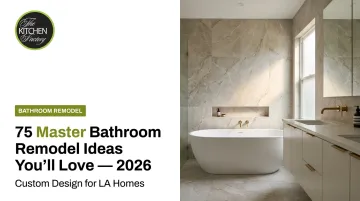
This guide organizes 75 master bathroom remodel ideas by category — layout, vanity, shower and tub, tile and materials, lighting, and décor — blending timeless principles with the strongest 2026 design directions. Whether you're planning a cosmetic refresh or a full gut renovation, this guide gives you the vocabulary, the benchmarks, and the visual direction to make confident decisions.
Key Takeaways
- Layout decisions (zoning, plumbing placement, and traffic flow) shape every other choice that follows
- 2026 vanity trends favor warm wood cabinetry, fluted fronts, mixed metals, and thick stone countertops
- Showers lead luxury upgrades: most homeowners prioritize the shower first, and frameless glass enclosures are the top choice by a wide margin
- Marble, polished nickel, and warm neutrals outlast seasonal trends — pair one statement piece with classic anchors
- Budget realistically: LA master bathroom remodels typically run $25,000 to $80,000+
Master Bathroom Layout and Space Planning Ideas
Layout is the decision that costs the most to fix later. Once plumbing walls are set and tile is down, changing the floor plan means a full demo. Getting it right the first time shapes how the room functions every single morning — not just how it looks.
One rule holds across every layout style: the toilet should never sit in direct sightline from the bedroom. Beyond that, most decisions come down to your space and how you use it.
1–5: Freestanding Tub as Centerpiece Layout
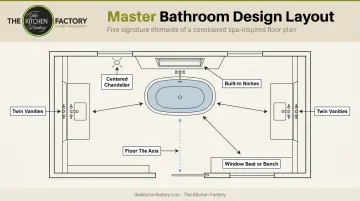
Position a freestanding soaking tub as the room's anchor, ideally near a window or beneath a skylight. The rest of the room orients around it:
- Twin vanities flanking the tub on opposite walls
- A chandelier centered directly above
- Built-in niches aligned to the tub's sightline
- Floor tile pattern running toward the tub as a focal axis
- Window seat or bench opposite the tub for visual balance
6–10: Double Vanity and Galley Layout
The galley layout places two vanities on opposite walls — generous individual space for couples with no elbow competition. For narrower rooms, a wall-to-wall double sink vanity with one long shared mirror achieves the same result in less square footage. Common configurations include:
- Back-to-back vanities with a center walkway for larger footprints
- Single long vanity with dual sinks and a continuous countertop for tighter spaces
- Offset placement with staggered mirror heights to break visual monotony
NKBA planning guidelines recommend lavatory centerlines at least 36 inches apart and a minimum 30 inches of clear floor space in front of each fixture — dimensions worth confirming before locking in any layout.
11–15: Wet Room and Open-Plan Layout
Wet rooms — where the shower and soaking tub share a single waterproofed tiled zone — now appear in 16% of renovated bathrooms, up 3 points year over year, according to recent NKBA bathroom trend data. Homeowners cite space efficiency (50%), aesthetics (29%), and accessibility (26%) as the primary drivers.
Keep sightlines open with frameless glass partitions rather than solid walls. The goal is a continuous visual flow from tub to shower to window, uninterrupted.
16–20: Dressing Room and Private Water Closet Layout
These two layout features show up consistently in higher-end Los Angeles remodels — and for good reason:
- Walk-in closet positioned between bedroom and bath, creating a seamless hotel-style morning flow
- Enclosed toilet room within the master bath — a staple in Bel Air and Beverly Hills remodels — that adds privacy without breaking the open feel of the main space
21–25: Compact Luxury and Grand Scale Layouts
For smaller master baths:
- Floating vanities open up floor area visually
- Corner tubs maximize footprint in tight layouts
- Glass-enclosed showers eliminate the visual weight of solid walls
- Large-format floor tile with minimal grout lines reads as more spacious
For large-footprint bathrooms:
- Varied flooring zones define bathing, vanity, and seating areas without walls
- Ceiling height changes (coffered over the tub, flat over the vanity) distinguish zones
- A dedicated seating or reading chair near the tub adds a finishing layer most homeowners overlook
Vanity, Cabinetry, and Storage Ideas
The vanity is the room's workhorse and its centerpiece simultaneously. In 2026, 55% of new vanities are custom or semi-custom, and wood tones lead all vanity finishes at 28% — ahead of white (20%) and off-white (10%).
26–30: Warm Wood and Fluted Cabinet Ideas
Light oak, white oak, and honey-toned finishes dominate the 2026 vanity landscape. Among wood vanities, white oak accounts for 23% of installations — a finish that pairs naturally with warm white countertops and unlacquered brass hardware.
Five approaches worth considering:
- Inset cabinet construction for a furniture-like, high-end feel
- Vertical fluted detailing on cabinet fronts for depth and texture
- Contrasting wood lowers with painted uppers (a kitchen technique crossing into bath design)
- Two-tone vanity in warm oak with a darker painted center section
- Open-grain wood with matte lacquer finish for a contemporary organic look
31–35: Floating Vanity and Open Shelving Ideas
Wall-mounted vanities visually expand floor area and photograph dramatically with LED strip lighting underneath. The floating effect works particularly well in smaller bathrooms.
- Wall-mounted vanity in dark walnut with under-cabinet lighting
- Floating double vanity in warm white oak with stone legs as visual grounding
- Open shelf unit beneath the vanity for towels and baskets
- Minimalist wall-hung console vanity in brushed steel for contemporary baths
- Mixed open-and-closed shelving unit with integrated LED panel
36–40: Countertop and Sink Ideas
Countertop preferences by installation share:
| Material | Share | Why Homeowners Choose It |
|---|---|---|
| Engineered quartz | 45% | Low maintenance, consistent patterning |
| Quartzite | 20% | Natural stone look with greater durability than marble |
| Granite | 14% | Unique veining, heat resistant |
| Marble | 13% | Unmatched luxury perception |
| Other | 8% | Concrete, porcelain slab, and specialty materials |
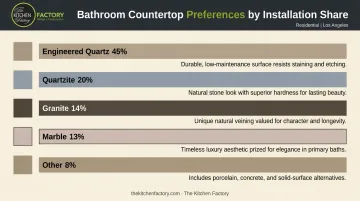
Quartz leads for durability; marble leads for luxury perception. Thick-edge marble slabs (2 cm or 3 cm) in Calacatta or Statuario read as unmistakably upscale.
Sink styles worth considering:
- Undermount double sinks for a clean countertop line
- Vessel sinks as sculptural accent pieces
- Shallow wading pool basin sinks for a spa-forward look
- Double-wide concrete sink for a distinctive, one-of-a-kind modern statement
41–45: Linen Cabinets, Built-Ins, and Smart Storage
The showroom-ready bathroom eliminates visual clutter through deliberate built-in storage:
- Tall inset linen cabinet in a contrasting finish flanking the vanity
- Recessed medicine cabinet with integrated lighting — 32% of renovators upgrade their medicine cabinet
- Built-in shower niches aligned at the same height as the vanity backsplash tile
- Integrated hamper pull-out inside vanity base cabinet
- Custom shelving unit built around or beside the freestanding tub
Non-standard alcoves and architectural features are where custom cabinetry earns its cost. The Kitchen Factory works with manufacturers including Wood-Mode and Eclipse Cabinetry specifically for these situations — configurations that catalog lines simply can't accommodate.
46–50: Mixed Metal Hardware and Mirror Ideas
Hardware choices shape a bathroom's personality as much as tile or stone. The mixed metals trend pairs:
- Unlacquered brass pulls with polished nickel faucets
- Matte black mirror frames with warm brass sconce arms
- Brushed gold hardware against a cool stone countertop
- Chrome towel bars with aged brass drawer pulls
Brushed nickel leads hardware finishes at 32%, followed by black at 18% and brushed gold at 14%.
Mirror shapes that shift the room's character: curved oval, arched with sculpted frame, wide shared mirror above a double vanity, or a pair of pivoting frameless mirrors for an editorial look.
Shower, Tub, and Wet Room Ideas
75% of homeowners upgrade their shower during a master bathroom remodel. Of those who choose a shower door, 75% go frameless. And 55% of NKBA respondents say a larger shower is more important than having a bathtub.
51–55: Walk-In Glass Shower Ideas
- Frameless glass enclosure with minimal hardware and floor-to-ceiling tile
- Black-framed glass shower for an industrial-modern contrast against warm wood vanity
- Glass shower with floor-to-ceiling tiled niche wall as the feature element
- Picture-frame window inside a large shower — natural light transforms the experience
- Curbless shower entry for both accessibility and clean aesthetic (chosen by 20% of shower upgraders)
56–60: Freestanding Tub Ideas
34% of renovators upgrade their tub, with soaking tubs accounting for 62% of new installations and freestanding flat-bottom tubs at 45%.
Styles to consider:
- Classic oval soaking tub centered beneath a window
- Double-ended tub for a symmetrical, hotel-suite look
- Sculptural egg-shaped tub as art object
- Hammered copper clawfoot tub for Victorian-meets-contemporary character
- Stone resin tub on a raised wood platform for an elevated spa look
61–65: Wet Room and Double Shower Ideas
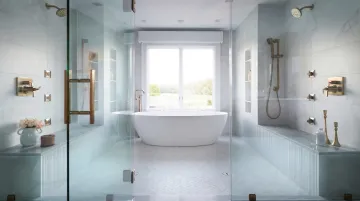
In a wet room, tile runs continuously from shower zone to tub zone — no threshold, no transition strip. Five designs that define the format:
- Double shower with two entry doors, individual rainfall heads, and built-in benches at each end
- Dual showerhead setup (rainfall overhead + handheld) as the baseline spa upgrade
- Continuous zellige tile from floor through shower ceiling for immersive texture
- Built-in steam shower with programmable aromatherapy controls (appears in 4% of renovated bathrooms — still rare, but the impact is unmistakable)
- Glass partition between wet room and dry vanity area, open at the top for light transfer
66–70: Tub Surround and Shower Upgrade Ideas
- Zellige tile tub surround for artisan texture and light play
- Herringbone tile backsplash extending from floor to ceiling behind the tub
- Architectural tub niche with plaster surround and floor-to-ceiling curtains (romantic, boutique hotel feel)
- Platform-mounted tub facing floor-to-ceiling glass for garden or canyon views
- Built-in shower bench in the same tile as the walls — seamless and functional
Tile, Materials, and Color Ideas
Material choices in 2026 lean toward warmth, texture, and natural movement. Cold, flat surfaces — think uniform subway tile on white grout — are giving way to surfaces with visual depth.
71–73: Tile Pattern and Natural Materials
High-impact tile ideas:
- Basketweave marble floors with pencil liner trim continuing into the shower base
- Herringbone pattern running wall-to-floor for visual continuity
- Floor-to-ceiling tile carrying up into the shower ceiling for an enveloping effect
- Matching wall and floor tile in the same large format for a seamless, expansive feel
- Zellige and handmade tiles for irregular texture and dimensional light reflection
Natural accent materials:
- Honed Calacatta marble for countertops and tub surround
- Natural wood ceiling beams or shiplap accent wall for warmth
- Dark stone cladding on a single feature wall for dramatic contrast
- Warm stone floors against a lighter stone vanity top
74–75: Color Palette Ideas
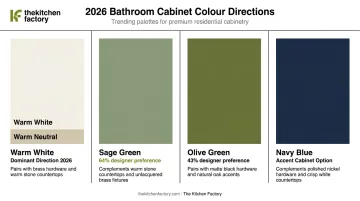
The dominant 2026 direction is warm white and warm neutral — a shift away from the stark bright whites of the previous decade.
For homeowners wanting more personality:
- Navy blue vanity cabinetry against white tile and brass hardware
- Sage or gray-green cabinets with warm stone countertops
- Painted ceiling in a deep lilac or navy as an unexpected accent
- Dark moody accent wall in charcoal or forest green behind the tub
The NKBA's 2026 Bath Trends Report identifies brown-based greens — sage (64%), olive (43%) — as the colors designers expect to dominate bathroom cabinetry this year.
Whatever cabinet color you choose, pair it with a fixture finish that will hold up over time. Chrome, polished nickel, and unlacquered brass all age gracefully and complement a wide range of palettes. For faucets, towel bars, and shower hardware — elements that are costly to swap out — timeless finishes are nearly always the smarter long-term investment.
Lighting, Décor, and Smart Bathroom Features
Lighting is where a bathroom stops looking finished and starts feeling intentional. 82% of bathroom renovations include upgraded lighting fixtures — and the difference between flattering light and harsh light is significant when you're looking in a mirror every morning.
Statement Lighting and Décor
Lighting ideas by type:
- Chandelier over the soaking tub — one fixture that repositions the entire room as a luxury space
- Sconces flanking mirrors at eye level for shadow-free task lighting (recessed lights create unflattering overhead shadows)
- Slim pendant lights over individual sinks in a double vanity
- LED mirrors with integrated lighting — appear in 24% of renovations, antifog systems in 22%
- Skylight positioned over the tub for natural daylight and evening stargazing
- Chromotherapy lighting inside a steam shower for spa wellness programming
Décor and window treatment ideas:
- Framed black-and-white photography or vintage prints to make the bathroom feel like a finished room
- Gallery wall against a dark-painted accent wall
- Illustrated or botanical wallpaper on a single wall or ceiling
- Floor-to-ceiling curtains framing the freestanding tub — romantic, immediately hotel-like
- Café curtains on lower window panes for privacy without blocking natural light
- Upholstered armchair or linen stool near the tub — a small addition that communicates genuine luxury
Smart and Wellness Upgrades
The global smart bathroom market was valued at $10.19 billion in 2025, projected to reach $24.83 billion by 2034. In luxury master bathrooms, these are the upgrades becoming standard in high-end remodels:
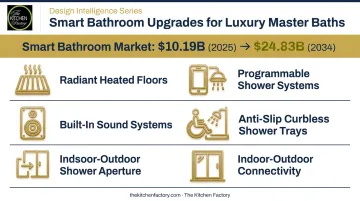
- Radiant heated floors — consistently rated the one upgrade homeowners refuse to live without after installing
- Programmable shower systems — brands like Moen and Kohler offer app and voice-controlled digital shower controls integrating water temperature, steam, lighting, and sound
- Anti-slip curbless shower trays — safety without sacrificing the clean aesthetic
- Built-in sound systems with in-wall or ceiling speakers
- Indoor-outdoor connectivity — glass walls extending tile to an exterior deck or garden for Southern California homes with the right orientation
How to Plan and Budget Your Master Bathroom Remodel
Every successful master bathroom remodel starts with three decisions made in the right order.
Decision 1: Layout first. Before selecting a single tile or faucet, confirm whether your layout requires moving plumbing walls. Relocating a toilet or shower drain significantly increases cost and timeline. If you can work within the existing footprint, you preserve budget for finishes.
Decision 2: Set a realistic budget. National data puts the primary bathroom remodel median at $15,000, with large bathrooms (100+ sq. ft.) at a $30,000 median and $75,000 at the 90th percentile. California primary bathroom remodels tend to run higher — $25,000 to $80,000+ — before factoring in LA labor rates and material lead times.
For context: a $10,000 budget may cover a cosmetic refresh — new vanity, fixtures, paint, and some tile work — in a smaller bathroom. It is not a realistic budget for a full luxury primary bathroom remodel in this market.
Decision 3: Assemble the right team. Treating design and construction as separate phases — handled by separate firms — is where most remodels go sideways. When a designer specifies something the contractor can't build to budget, or a contractor makes field decisions that undermine the design intent, the client absorbs both the cost overrun and the disappointment.
A design-build model eliminates that gap. At The Kitchen Factory, we've operated under one fixed-cost agreement in greater Los Angeles since 1988 — keeping design, cabinetry selection, measurement verification, and coordinated installation under a single point of contact. We produce 3D renderings before anything goes to production, so you approve the finished room before a single wall opens.
Common Mistakes to Avoid
- Choosing trendy finishes for permanent fixtures — one statement trend piece paired with timeless classics outlasts a fully trend-driven room by a decade
- Underestimating timeline — construction averages 20–30 working days; total project time from planning through completion typically runs six weeks to three months
- Skipping the design phase — bathrooms with a thorough design phase have fewer change orders, fewer cost overruns, and better outcomes
Homeowners in the greater Los Angeles area — from Studio City and Bel Air to Brentwood and Pacific Palisades — can connect with The Kitchen Factory for a personalized design consultation to walk through layout options, cabinetry selections, and finish coordination before committing to a scope.
Frequently Asked Questions
Is $10,000 enough for a master bathroom remodel?
Nationally, $10,000 can cover a cosmetic refresh — new vanity, fixtures, paint, and minor tile updates — in a smaller bathroom. In the greater Los Angeles market, where full master bath remodels typically run $25,000 to $80,000+, that budget is well below the median. Focus spend on high-ROI elements: vanity, shower, and flooring stretch any budget furthest.
What is the hottest bathroom trend in 2026?
Warm wood cabinetry (light oak, white oak), fluted vanity fronts, and mixed metal finishes — particularly unlacquered brass paired with polished nickel — lead the 2026 design direction. Frameless glass walk-in showers and wet room layouts continue gaining ground, alongside a broad shift toward warm neutral palettes and spa-influenced spatial planning.
What bathroom features add the most value to a home?
Walk-in showers, quality vanities and countertops, updated flooring, and custom cabinetry consistently deliver the strongest return. The Zonda 2025 Cost vs. Value Report benchmarks a midrange bath remodel at roughly 80% cost recouped nationally — though Los Angeles market conditions can shift that figure meaningfully in either direction.
Should I keep a bathtub or convert to a walk-in shower?
Primarily a lifestyle decision — 55% of NKBA respondents rate shower size as more important than having a tub. In a luxury master bath with enough square footage, pairing a freestanding soaking tub with a walk-in shower is the premium choice and the one most likely to appeal to high-end buyers.
How long does a master bathroom remodel typically take?
Construction averages 20–30 working days; total project time from planning through final installation typically runs six weeks to three months. Custom cabinetry and specialty tile often have the longest lead times — factor those into your start date before committing to a move-out or renovation window.
What vanity style is most popular for master bathrooms in 2026?
Warm wood vanities in light oak or white oak with fluted cabinet fronts dominate 2026 preferences, typically paired with thick marble countertops and brass or mixed-metal hardware. Floating vanities in darker finishes remain the top choice for contemporary and minimalist aesthetics, especially in smaller bathrooms where visual floor space matters.